
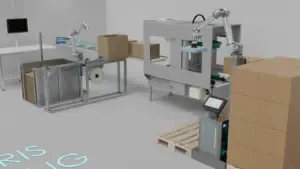
Automated Stacking: continuous flow and perfect bundles at end-of-line

Automate end-of-line stacking to maintain production flow, improve bundle consistency, and reduce manual handling with greater safety.


📍Toledo, Castilla- La Mancha, España.

Project

Description

The project was driven by the need to modernise and stabilise the discharge process of a roll forming line, with a specific focus on the automated stacking of profiles and their extraction. The initial situation meant that stacking relied heavily on manual handling and operator adjustments to achieve properly aligned bundles, directly affecting cycle times, safety, and the consistency of the finished product.

With the implementation of an automated stacking system, the goal is to reduce process variability, ensure repeatable alignment, and minimise operator intervention, achieving a more stable outfeed flow. In addition, automated stacking helps maintain constant bundle quality, avoiding downstream corrections and improving safety in a critical handling area. Overall, the automated stacking solution is positioned as the main lever for increasing productivity, process reliability, and uniformity in the stacked product.

The objective of the project is to implement an automated end-of-line stacking system capable of sorting, picking, and forming profile bundles in a repeatable way, while maintaining production continuity and improving working conditions. The solution is developed for an industrial environment, integrating with an existing line under real plant operating conditions.


Con la implantación del Apilado automatizado, se busca reducir la variabilidad del proceso, asegurar una alineación repetible y minimizar la intervención del operario, logrando un flujo de salida más estable. Además, el Apilado automatizado permite mantener una calidad constante de los paquetes, evitando correcciones posteriores y mejorando la seguridad en una zona crítica de manipulación. En conjunto, el Apilado automatizado se plantea como el eje principal para aumentar la productividad, la fiabilidad del proceso y la uniformidad del producto apilado.

El objetivo del proyecto consiste en implantar un final de línea automatizado de apilado, capaz de ordenar, recoger y conformar paquetes de perfiles de manera repetible, manteniendo la producción y mejorando el entorno de trabajo. La solución se desarrolla en un entorno industrial, integrándose con una línea existente y con operativa real de planta.

The

Challenge

The main challenge was to turn a critical phase — profile discharge and bundle formation — into a reliable and continuous process, avoiding stoppages and reducing dependency on manual intervention to align and build the bundles. This required ensuring that the profiles always reached the handling area in the right position, without variability that could compromise the performance of the automated stacking system.

In addition, the end-of-line had to allow production to keep moving while necessary tasks such as strapping and bundle removal were being carried out. In practice, this requires a design capable of absorbing the production flow and managing the buffer in an orderly way, preventing bottlenecks during peak output periods.

Finally, there were key integration and safety constraints: working on an existing machine, coordinating equipment and movements within a real industrial environment, and guaranteeing safe operator access whenever intervention was required in the extraction area. All of this had to be achieved with clear expectations in terms of robustness, ease of operation, and a process that would not depend on constant adjustments.

Además, el final de línea debía permitir que la producción siguiera avanzando mientras se realizaban tareas necesarias como el flejado y la retirada de paquetes. En la práctica, esto exige un diseño que absorba el flujo de producción y gestione el “buffer” de forma ordenada, evitando cuellos de botella en momentos de alta carga.

Por último, había condicionantes relevantes de integración y seguridad: trabajar sobre una máquina existente, coordinar equipos y movimientos en un espacio industrial real, y garantizar un acceso seguro para los operarios cuando toca intervenir en la zona de extracción. Todo ello con expectativas claras de robustez, facilidad de operación y un proceso que no dependiera de ajustes constantes.

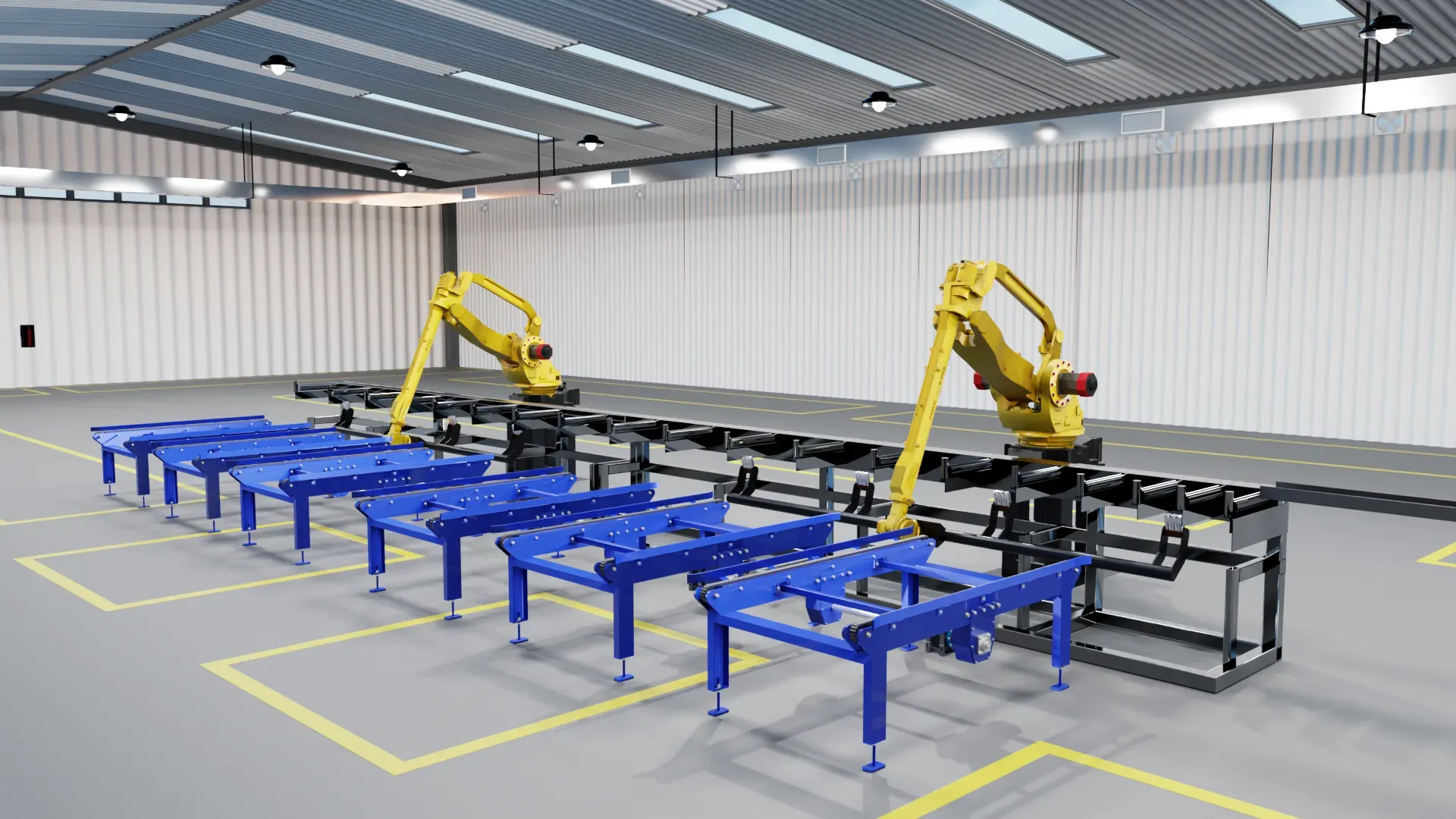
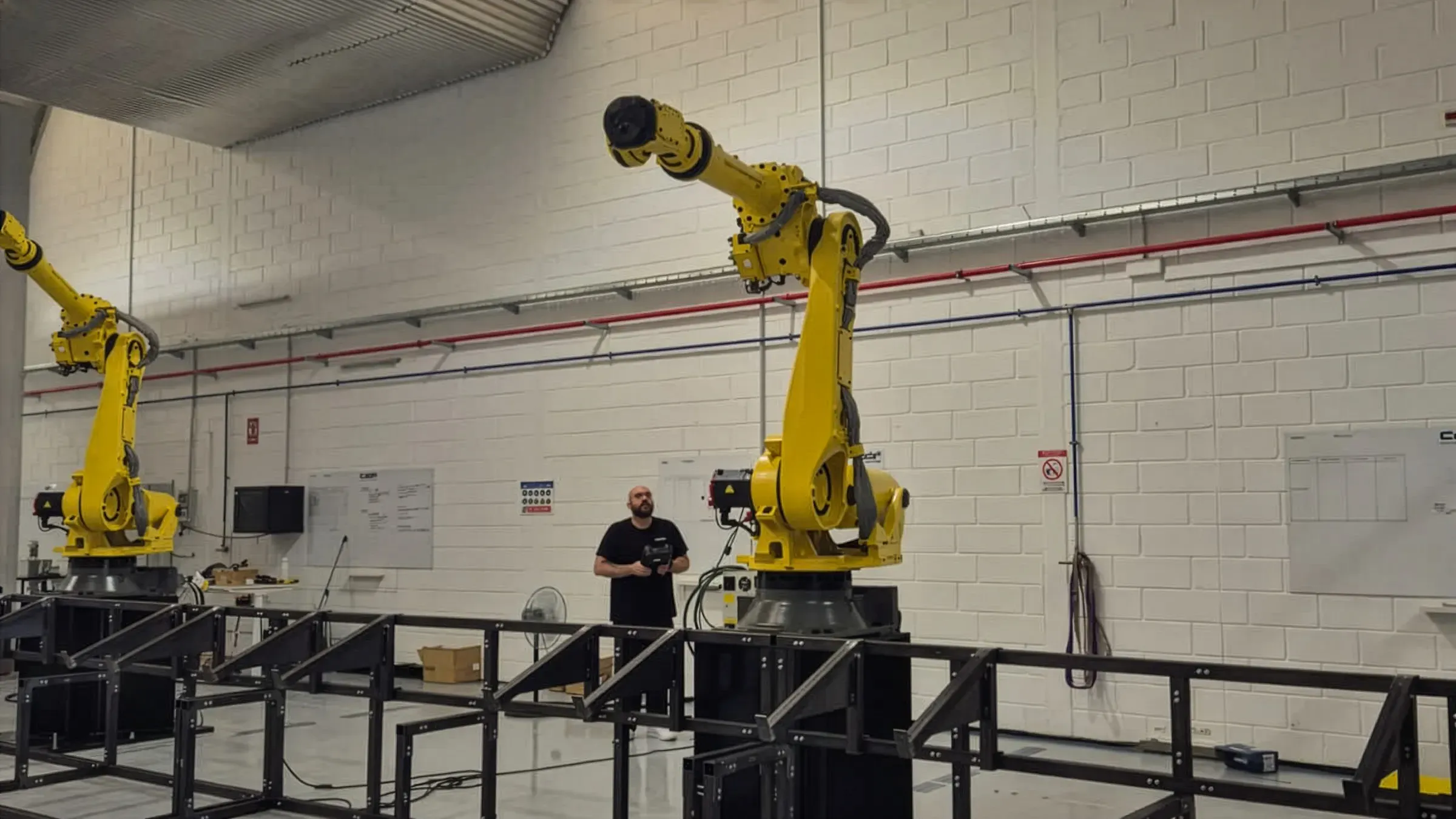
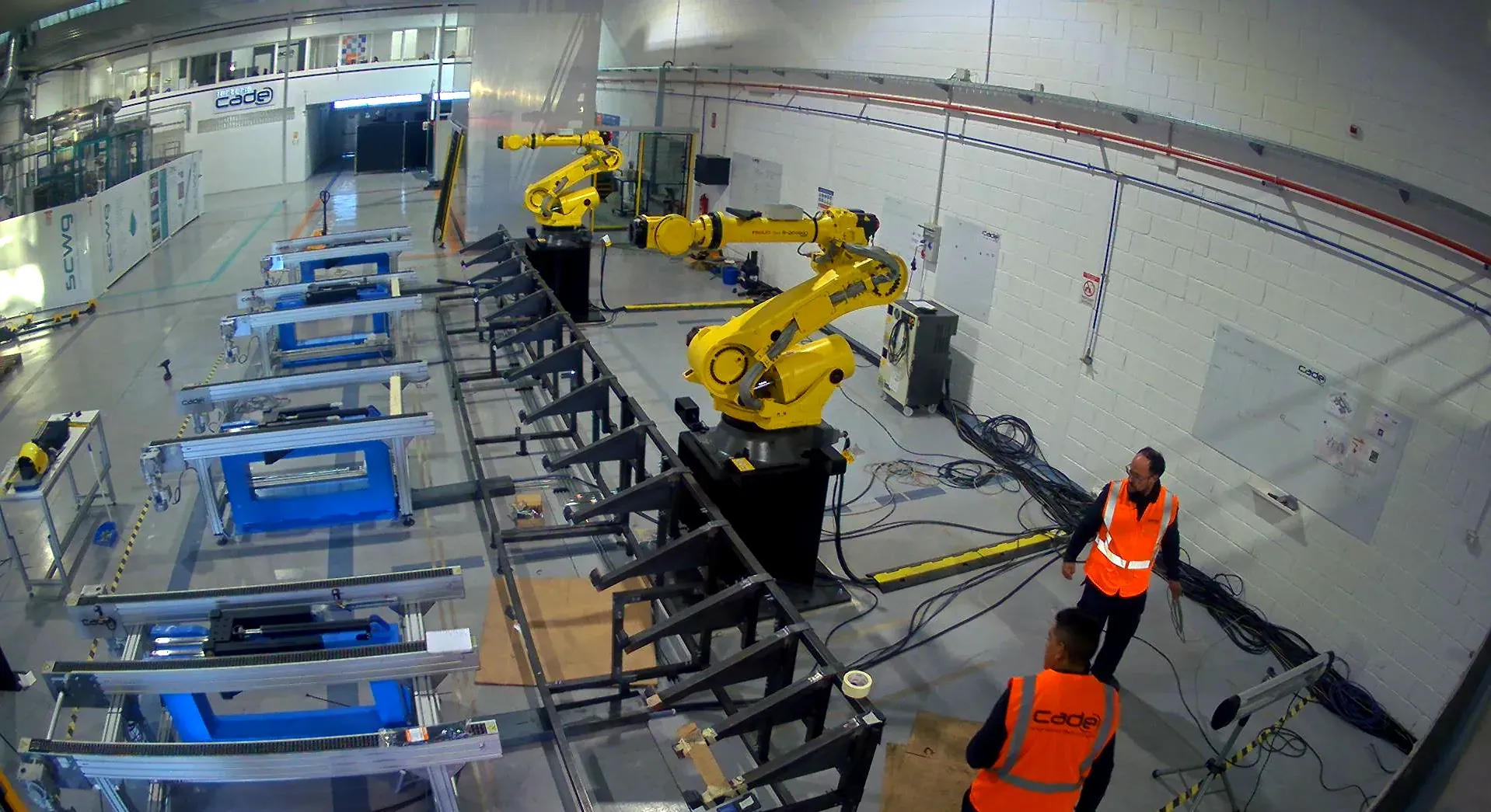
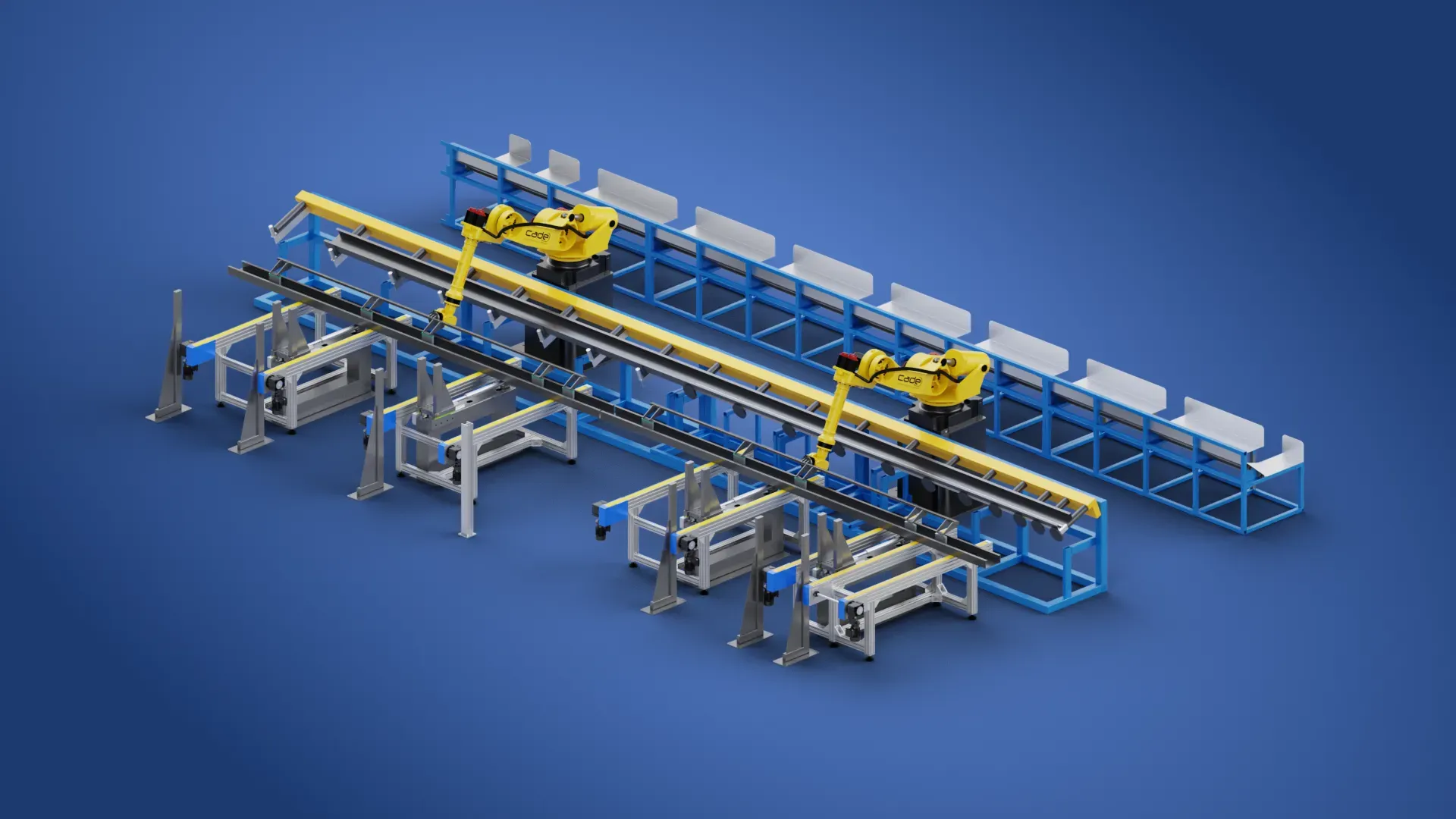
The solution was conceived as an automated end-of-line system designed to ensure correct profile alignment and preparation in the pick-up area, so that stacking could be stable and repeatable. On this basis, the roller outfeed and the necessary mechanical integration were adapted to guarantee consistent delivery to the handling system.

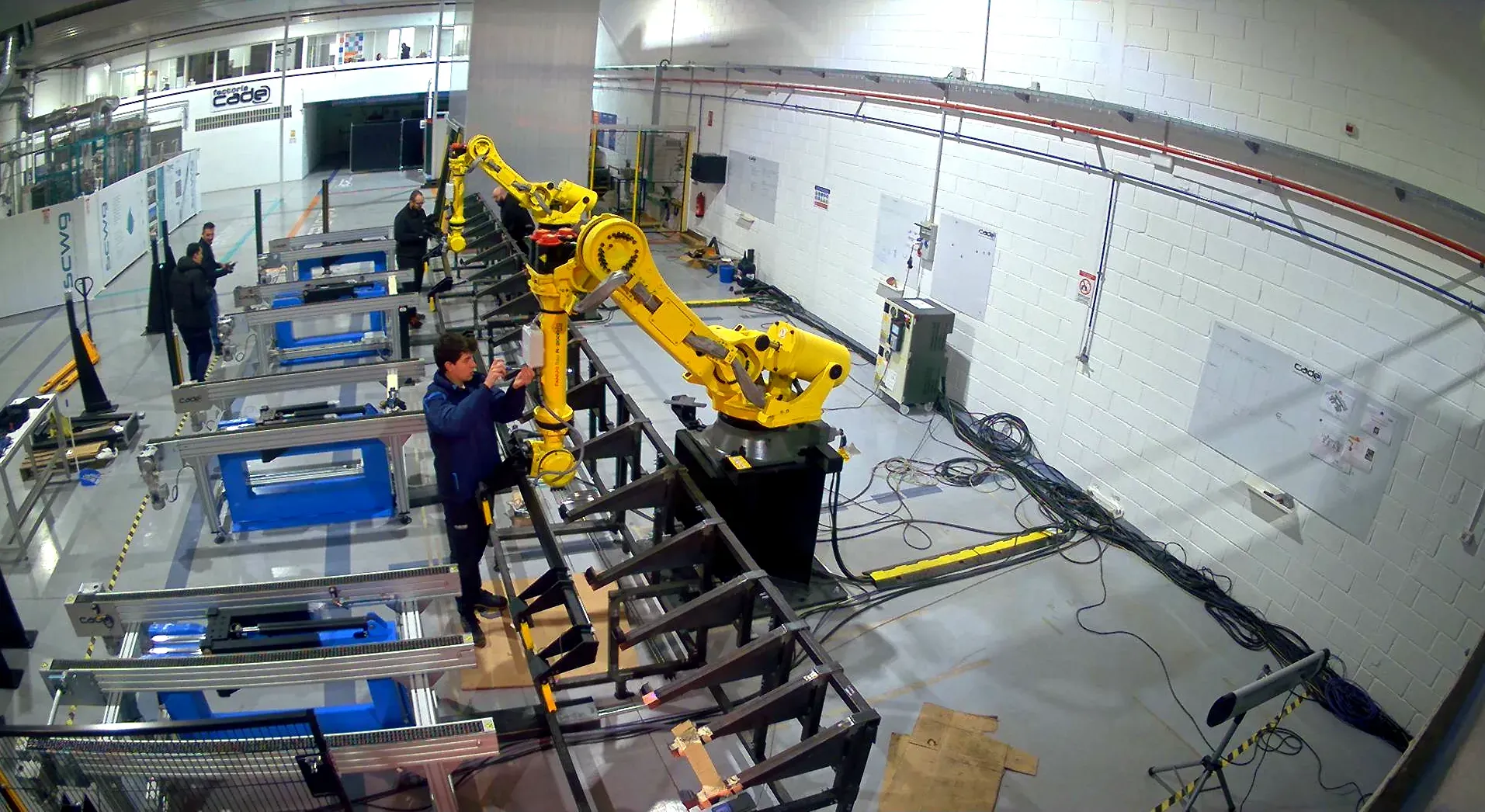
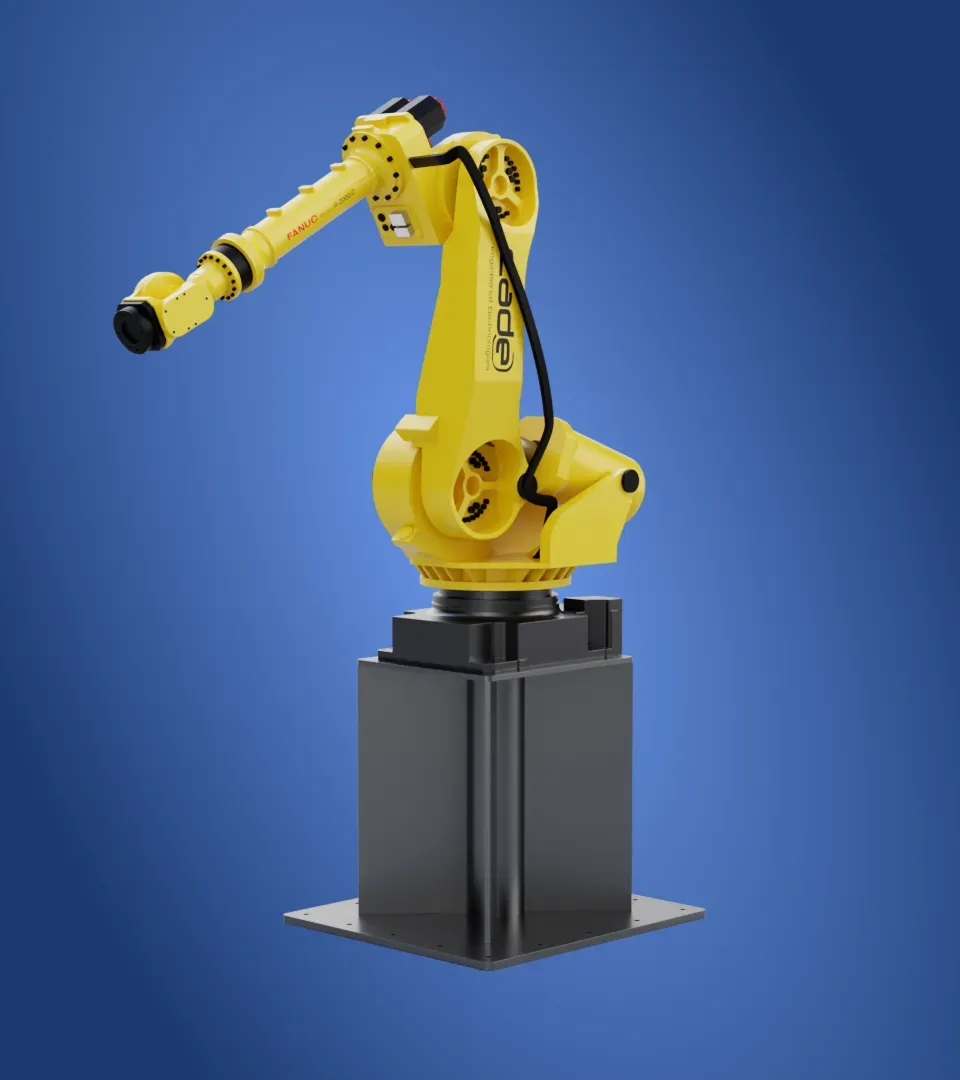
From there, a robotic handling system with custom grippers was integrated, selecting the most suitable gripping method according to the profile characteristics and plant operating requirements. The objective was to ensure precise, continuous stacking with minimal manual intervention.

The system is completed by a motorised extraction and compacting station designed to form well-defined bundles and manage the outfeed of multiple bundles, allowing strapping and removal operations without interrupting production.

The entire solution is integrated with touchscreen control and a perimeter industrial safety system to ensure reliable operation under safe working conditions.

A partir de ahí, se integró un sistema de manipulación robotizada con garras a medida, seleccionando el método de agarre más adecuado según las características del perfil y la operativa de planta. El objetivo fue asegurar un apilado preciso, continuo y con mínima intervención manual.

El conjunto se completa con una bancada motorizada de extracción y compactado para formar paquetes bien conformados y gestionar la salida de varios paquetes, permitiendo flejado y retirada sin bloquear la producción.

Todo el sistema se integra con control mediante pantalla táctil y un esquema de seguridad industrial perimetral para operar con garantías.

CADE

Solution

Results

With the implementation of the system, the end-of-line moves to a model based on repeatability and stability: profiles arrive aligned, are picked consistently, and are stacked with a much more controlled bundle geometry. This translates into a more orderly production outfeed and a reduction in incidents associated with misalignment or poorly formed bundles.

From an operational standpoint, the availability of a station designed to manage multiple bundles makes it possible to maintain production continuity while strapping and removal tasks are carried out, improving overall flow and avoiding stoppages caused by congestion at the end-of-line. At the same time, the physical strain associated with manual profile handling is reduced, improving ergonomics and process stability across shifts and demand peaks.

In terms of safety and control, the solution delivers a more protected working environment, with operation guided and supervised through the control system. The result is an end-of-line better prepared to grow in performance and production demand, supported by an automated foundation that reinforces stacking quality, process efficiency, and plant responsiveness.


Otros Proyectos

Layout Detalle Maquinas copia WEBP

Medical Production Line Automation

Medical Production Line Automation Collaborative Robotics and Traceability Integration to Optimize Medical Manufacturing   Project Description CADE successfully delivered a turnkey EPC project for ULB Medical, aimed at creating an
Read More »
pwht-tratamiento-termico-post-soldadura

Structural Integrity Assessment During Local PWHT

Structural Integrity Assessment During Local PWHT Post weld heat treatment (PWHT) is a thermal treatment usually  performed in steels that have been welded. Its object is to ensure that the welding properties are suitable for its expected operation according to

Read More »

Albacete

Parque Científico y Tecnológico

Paseo de la Innovación 3, 02006 Albacete – España

Tel. +34 967 19 01 72

Madrid

C/Raimundo Fernández Villaverde, 53 (Entreplanta)

28020

Madrid – España

Albacete

Parque Científico y Tecnológico

Paseo de la Innovación 3, 02006 Albacete – España

Tel. +34 967 19 01 72

Madrid

C/Raimundo Fernández Villaverde, 53 (Entreplanta)

28020

Madrid – España

Contact us

I guess you are interested in what we do

If you please, contact us and tell us about your project to inform you what we can do for you

Can we call you?

We inform you about our engineering solutions