
Turnkey line to industrialise tank shell manufacturing
Fully integrated automation of cutting, assembly and welding to increase throughput, quality and repeatability.
📍Castilla-La Mancha, España.
Project
Description
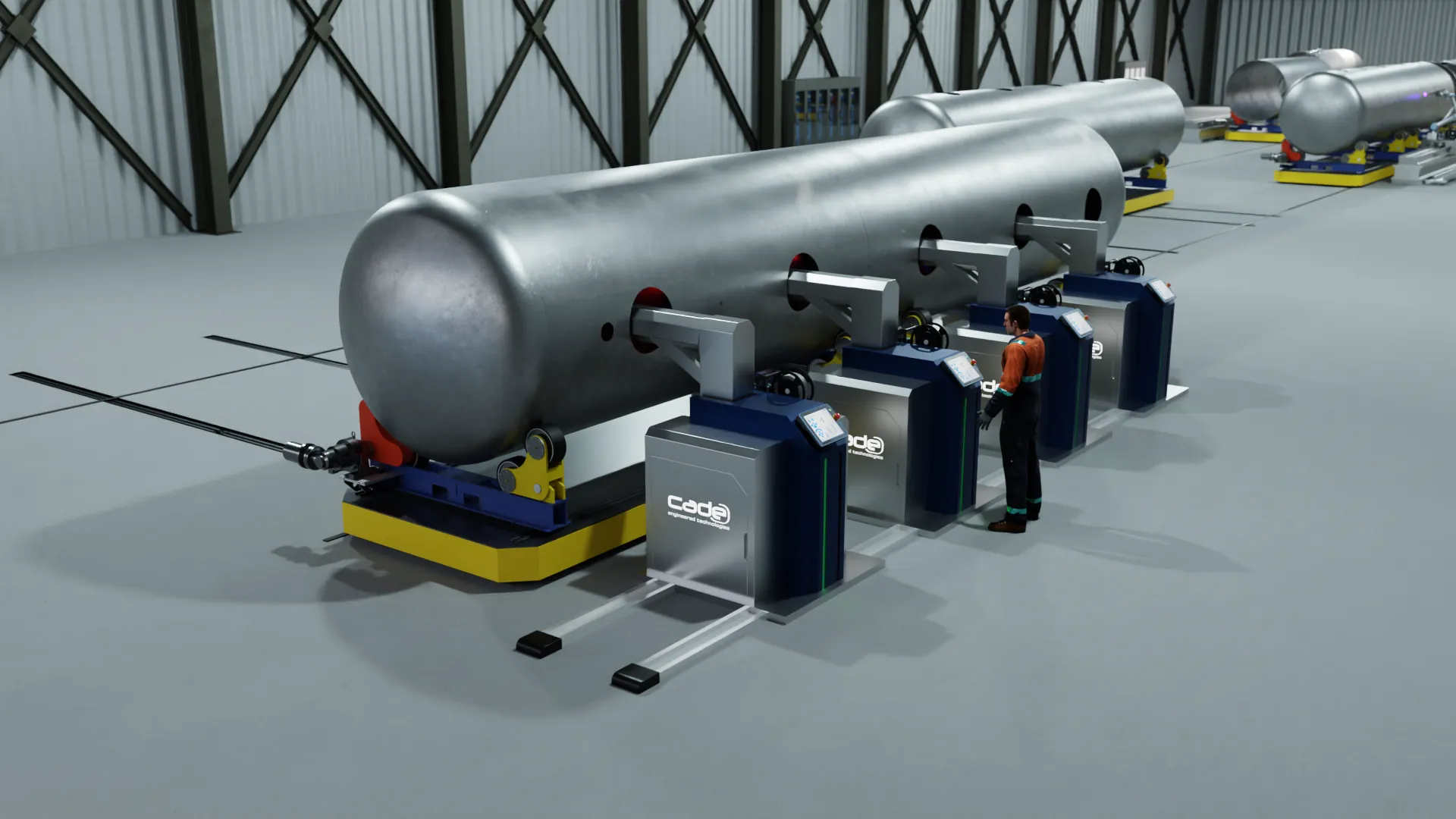
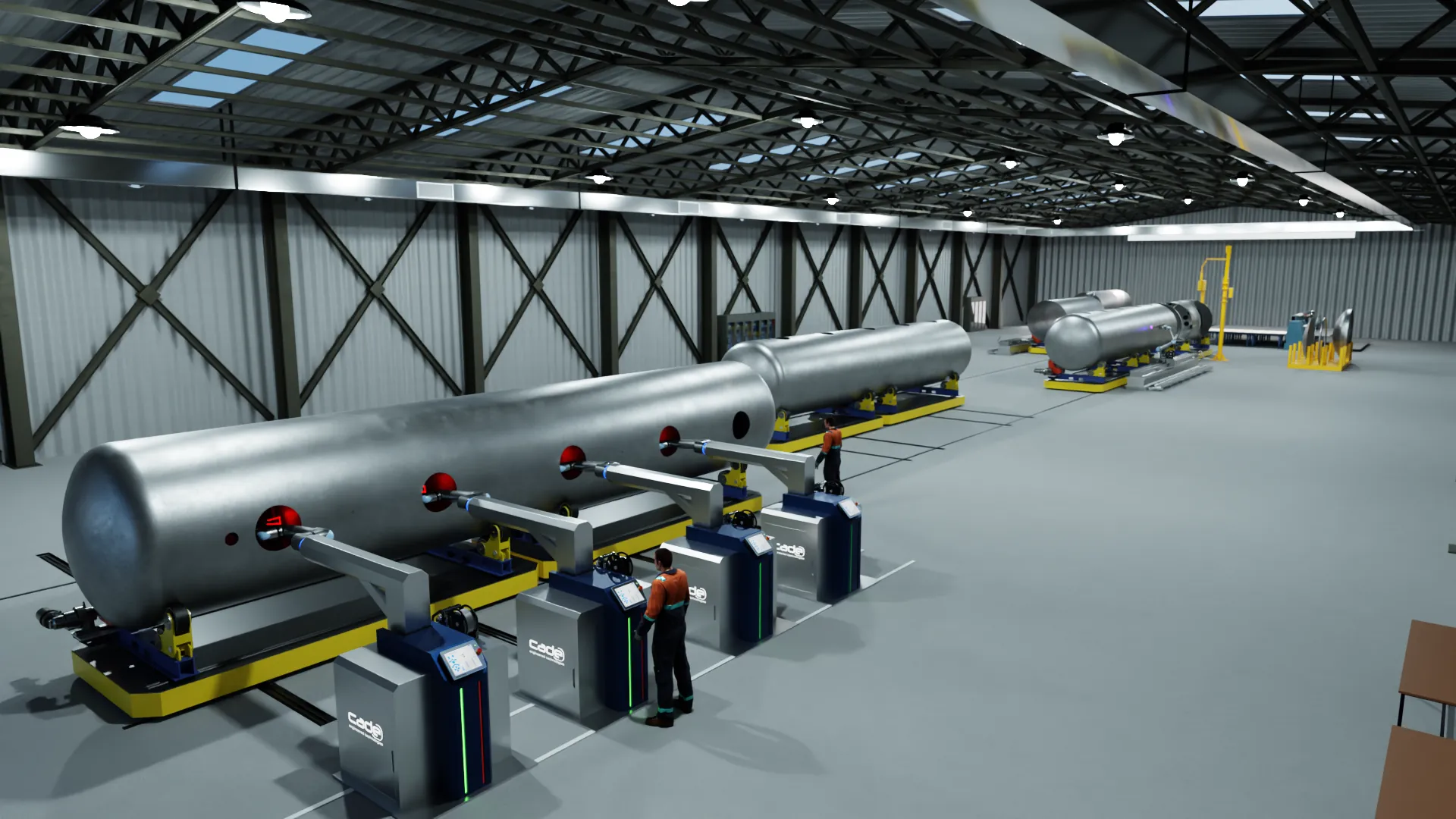
The project addresses the design and implementation of a complete production line to industrialise tank shell manufacturing, continuously integrating the stages of shell preparation, assembly and automated welding.
The solution is conceived as a turnkey system, made up of coordinated stations that ensure geometry, precision and process stability, from the initial preparation stage through to the final internal welds, with a clear focus on repeatable production.
The
Challenge
Tank shell manufacturing combines operations with high dimensional requirements and a strong dependence on manual work: precise edge preparation, positioning, assembly of heads and internal components, centring and circumferential closure, together with complex internal welding operations constrained by accessibility and ergonomics.
The main challenge is to transform this set of tasks into a consistent industrial flow, capable of maintaining tolerances, minimising deformation and reducing rework, without compromising safety or increasing the physical strain on the team.
Added to this is format variability, which demands genuine flexibility to adapt to changes without turning every adjustment into a long stoppage or a costly process reconfiguration.
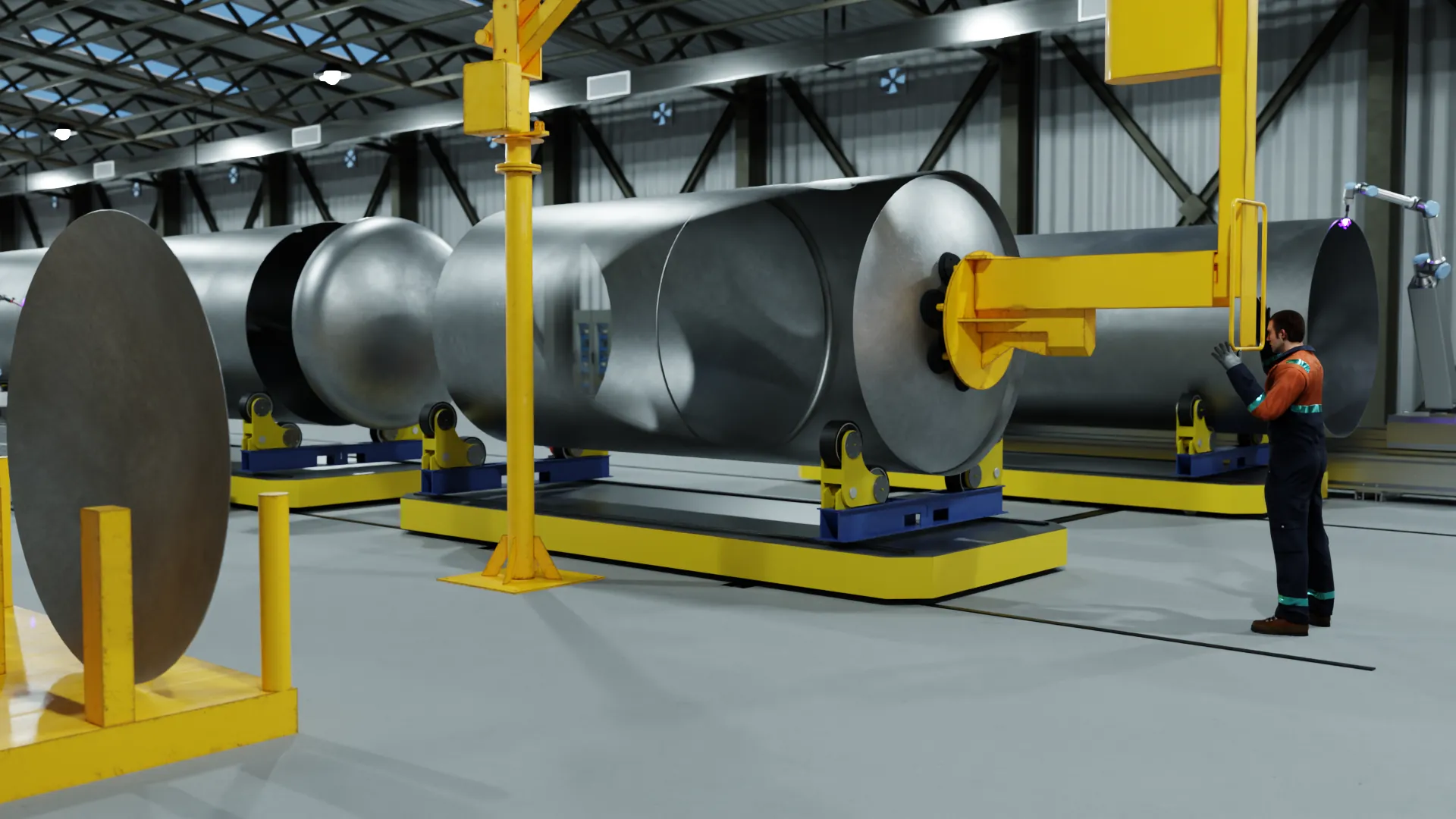
The proposed solution structures the process into specialised stations that stabilise geometry before welding and automate the critical stages.
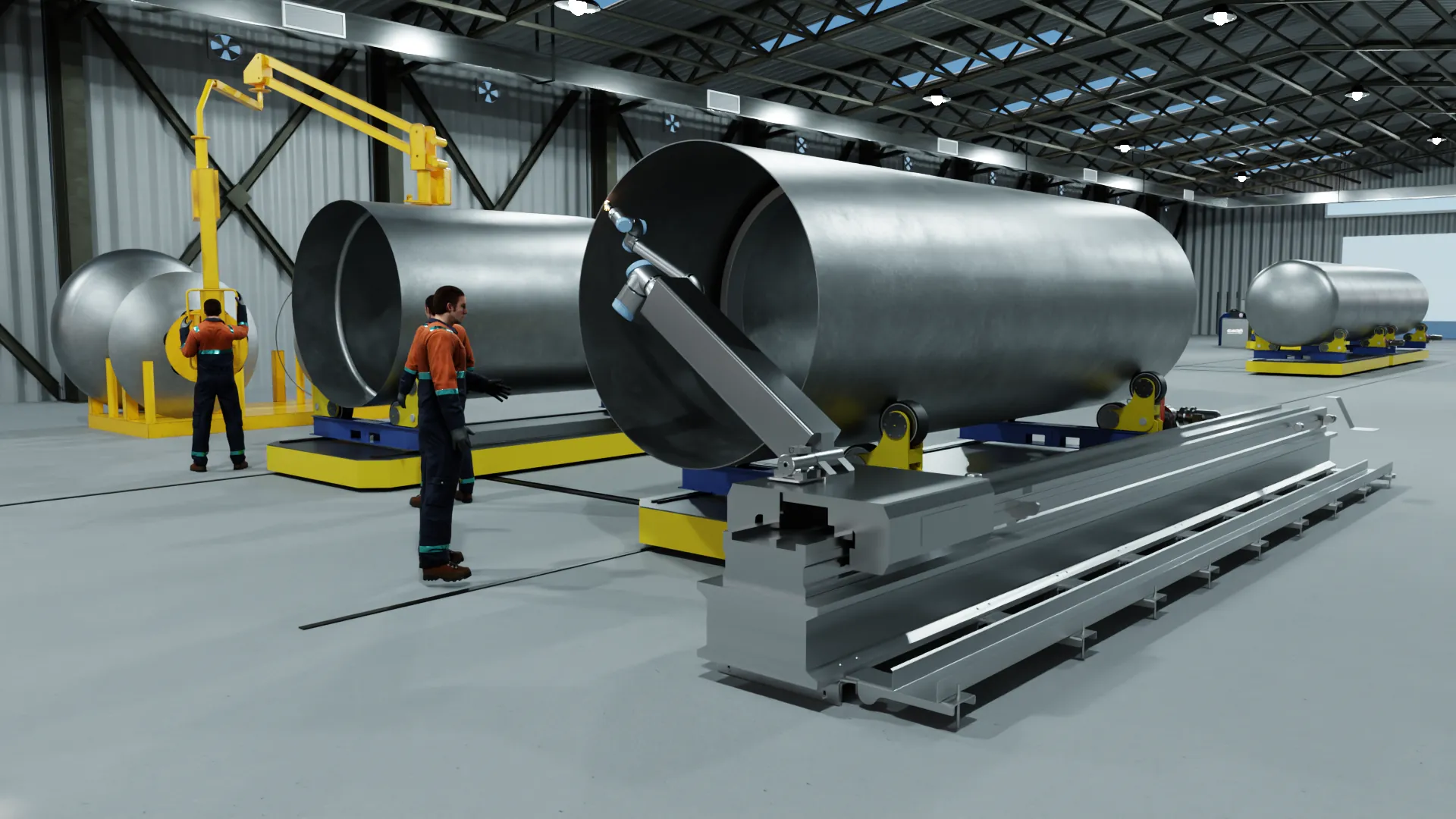
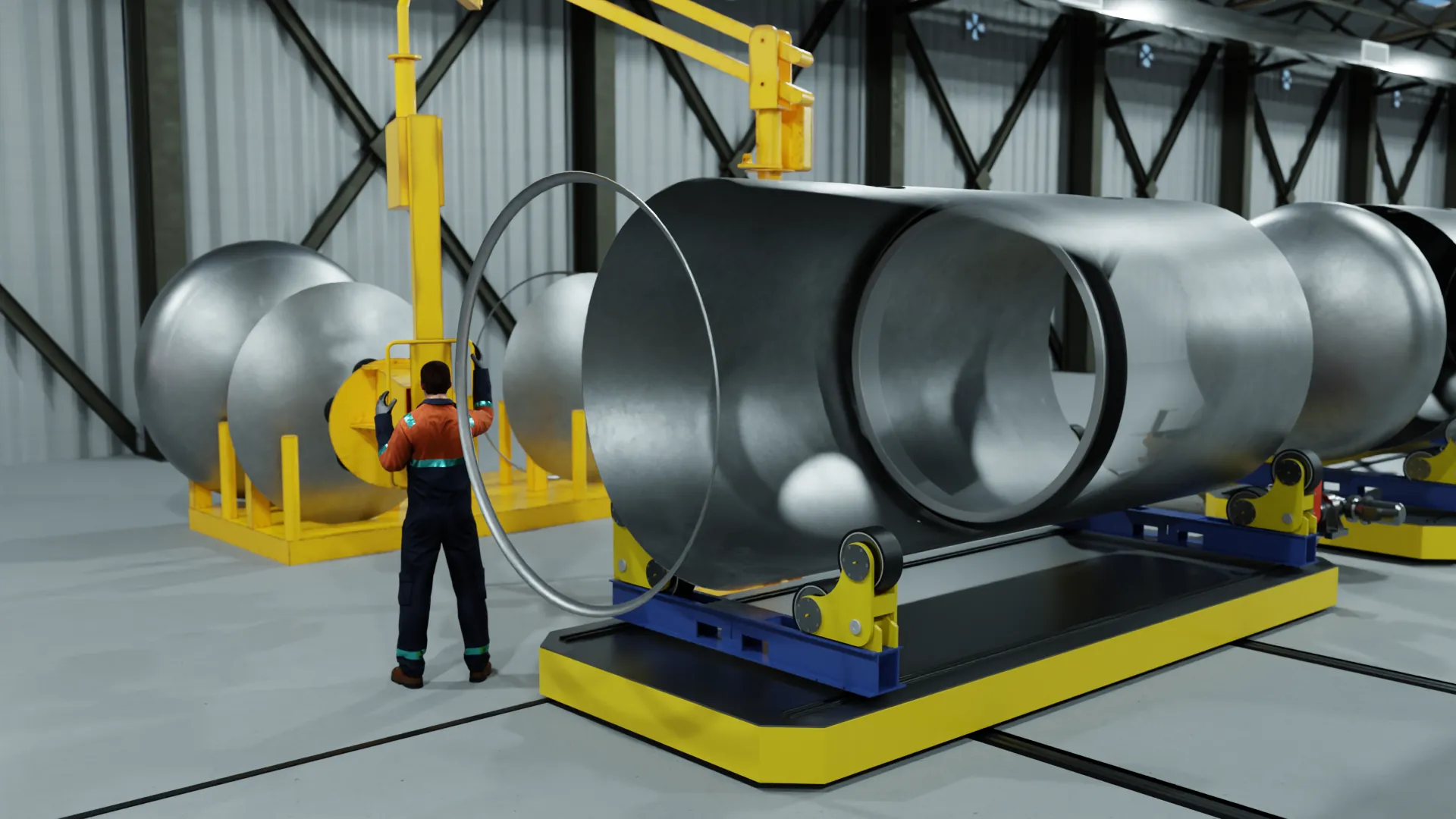
First, a preparation station performs the cutting and edge facing of the shell sections, ensuring parallel faces and repeatable conditions for downstream operations. This is followed by an assisted assembly station that optimises the positioning of internal components and heads, incorporating centring tools that maintain roundness and improve tack welding repeatability.
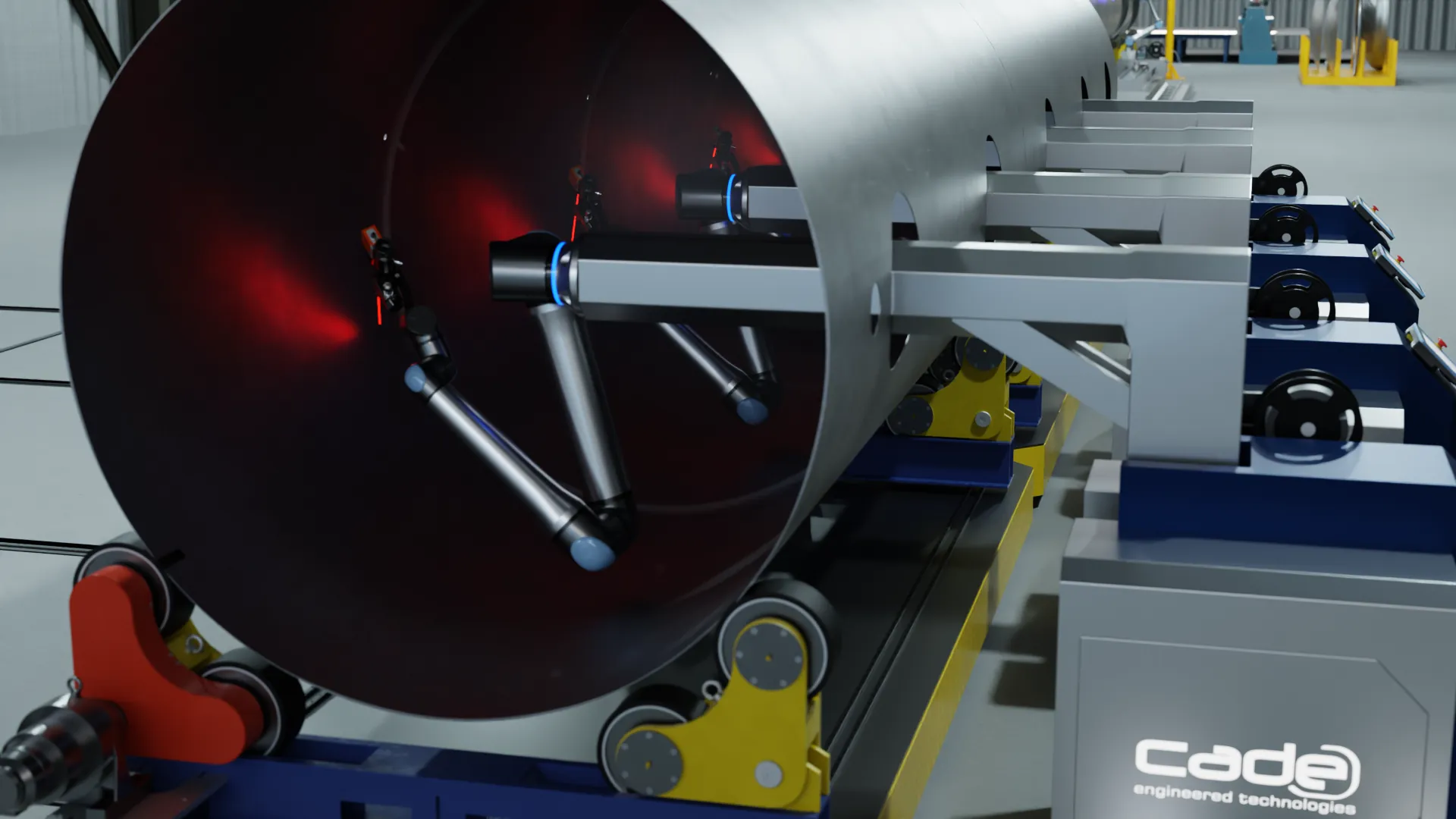
For closure of the assembly, the line incorporates a robotic centring and circumferential welding station, designed to ensure joint uniformity and weld seam stability. Finally, a robotic internal welding station systematises the welds inside the shell, reducing dependence on slow, demanding manual work and increasing the consistency of the final result.
CADE
Solution
Results
The expected outcome is a clear increase in productivity thanks to a more stable flow, more clearly defined processing times by station, and reduced dependence on manual adjustments and downstream corrections.
In terms of quality, the line is designed to consolidate dimensional accuracy and more homogeneous closures, with a particular impact on circumferential welds and internal welding operations, where automation brings repeatability and control.
In addition, improvements in ergonomics and safety reduce operator exposure to awkward tasks and forced postures, enabling a more predictable, scalable operation that is better prepared to handle format variations without losing consistency.
Otros Proyectos

3D Point Cloud Generation to Modify Existing Systems
3D POINT CLOUD GENERATION TO MODIFY EXISTING SYSTEMS OBJECTIVE In projects for the modification or upgrading of existing industrial facilities, CADE regularly performs 3D laser scans in plants, in order
Piping Stress Analysis and Finite Element Analysis (FEA) For Creep Effect Evaluation
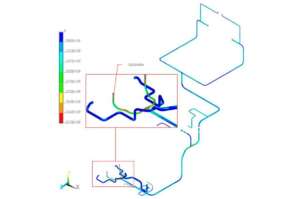
PIPING STRESS ANALYSIS AND FINITE ELEMENT ANALYSIS (FEA) FOR CREEP ASSESSMENT The owner of a steel plant in DURGAPUR (India) requested CADE to assess the remaining life and mechanical integrity

Fatigue Analysis Of Process Equipment Using Finite Element Method
FATIGUE ANALYSIS OF PROCESS EQUIPMENT USING FINITE ELEMENT METHOD OBJECTIVE A significant supplier of process equipment and pressure vessels requested CADE’s services to perform design validation for fatigue of a

Structural Analysis of Railway Rolling Stock Incorporating Suspension System
Structural Analysis of Railway Rolling Stock Incorporating Suspension System Advantages of incorporating the suspension system to finite element analysis CADE normally uses the Finite Element Method (FEM) to undertake simulation