

Automatic palletising of paint cans
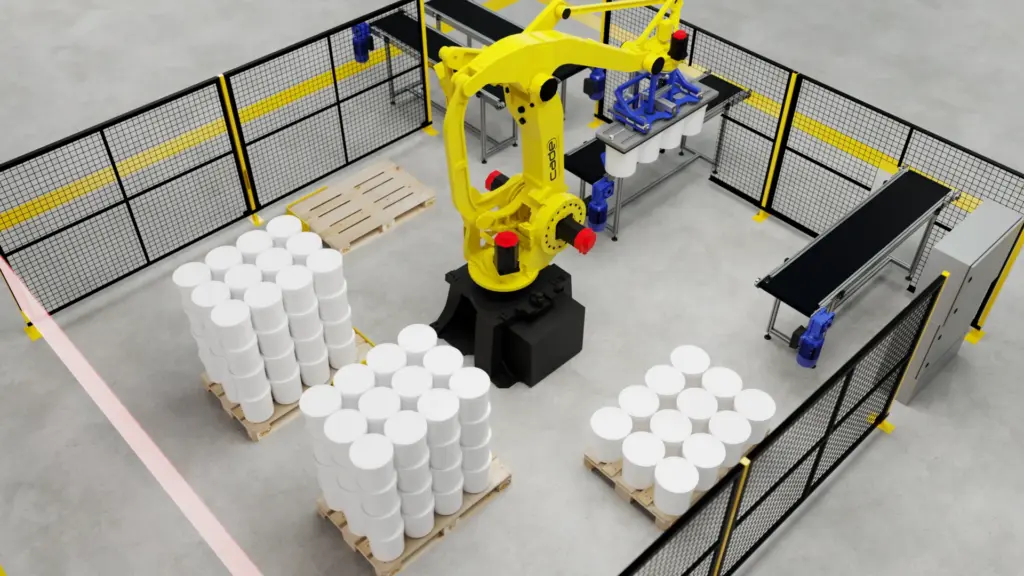
Industrial automation project for an automatic paint can palletising cell with industrial robot, motorised conveyor and four palletising stations.
Project Description
Automatic palletising cell solutions for paint cans help automate a critical end-of-line stage, improving pallet formation and reducing dependence on manual operations. In this project, CADE developed an industrial palletising cell capable of picking containers in an orderly way, adapting to different formats and building pallets in a stable, repeatable and safe manner.
The solution was designed to work with two can formats, with differences in weight, dimensions and throughput, while maintaining a continuous flow from the line outfeed to the palletising area. The system had to ensure precise product handling as well as correct outfeed organisation, preventing misalignments that could affect stack stability or production continuity.
From the outset, the project was approached with a clearly plant-oriented view: the goal was not simply to add a robot, but to design a complete industrial automation solution integrating conveying, handling, control and safety. The result is an installation conceived to improve palletising uniformity, reduce manual intervention and bring greater operational robustness to a key process area.
This automatic palletising cell was designed to improve end-of-line reliability, palletising uniformity and operational safety in daily plant operation.
The Challenge
The main challenge of the project was to transform a final stage traditionally highly dependent on manual intervention into a more stable, continuous and predictable operation. The installation had to manage product outfeed from several packaging lines, absorb different operating rates and maintain an orderly feeding sequence towards the palletising area.
Added to this was the need to handle different can formats without compromising stack stability. The system had to guarantee reliable picking, accurate placement on the pallet and an operating logic capable of maintaining the quality of the final unit load, even under demanding operating conditions and with different line speeds depending on the format.
There were also the usual constraints of any real production environment: integration with the existing installation, coordination between conveying and robotic handling, replenishment of empty pallets, removal of full pallets and compliance with industrial safety requirements. All of this had to be solved without creating a rigid system, but rather a robust solution prepared for day-to-day plant operation.
A esto se sumaba la necesidad de manipular distintos formatos de bote sin comprometer la estabilidad del apilado. El sistema tenía que garantizar una recogida fiable, una colocación precisa sobre pallet y una lógica de funcionamiento capaz de mantener la calidad del conjunto final, incluso en una operativa exigente y con cadencias diferentes según el formato.
También existían condicionantes propios de cualquier entorno productivo real: integración con la instalación existente, coordinación entre transporte y manipulación robotizada, reposición de pallets vacíos, retirada de pallets completos y cumplimiento de los requisitos de seguridad industrial. Todo ello debía resolverse sin generar un sistema rígido, sino una solución robusta y preparada para el trabajo diario en planta.
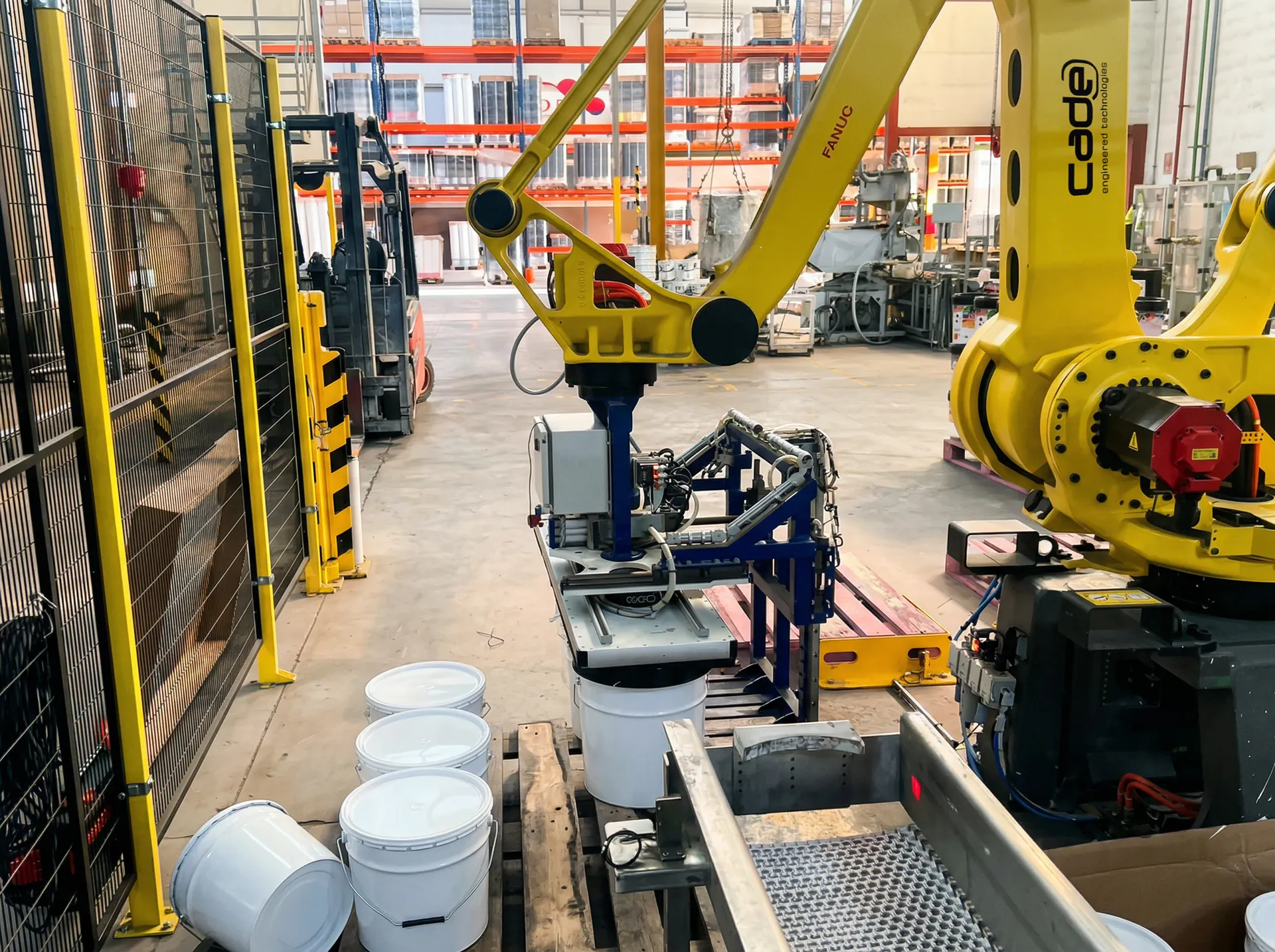
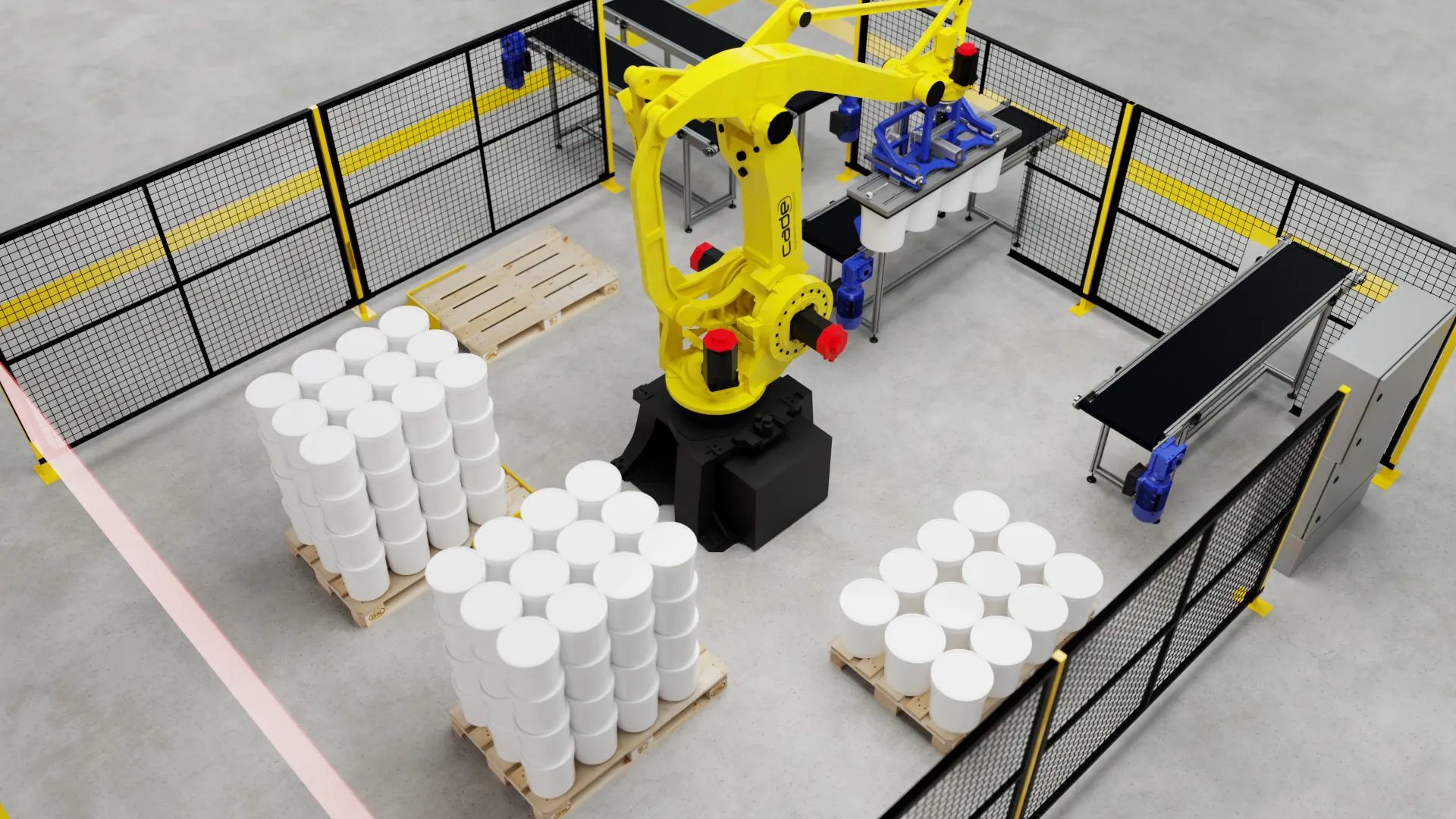
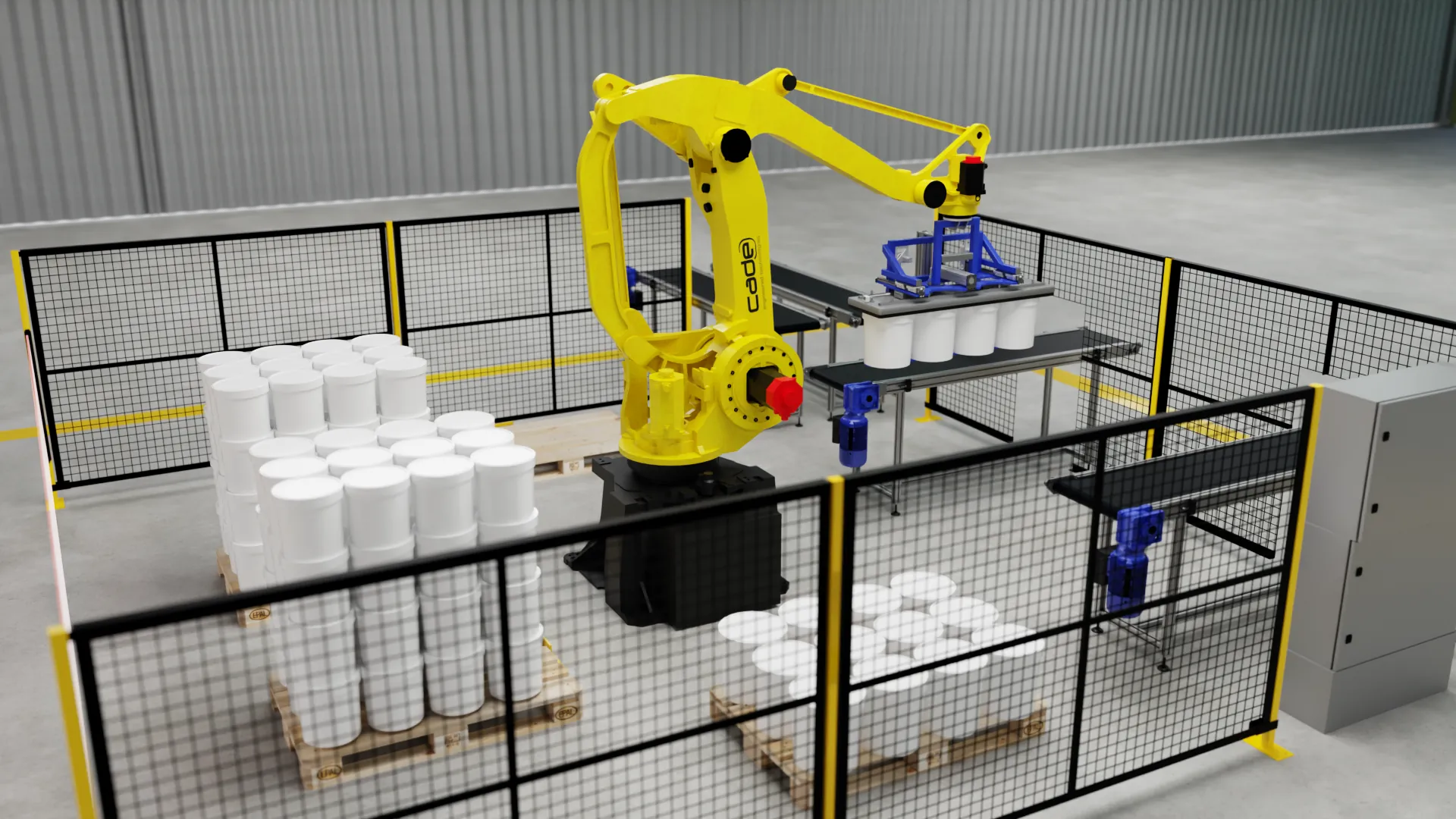
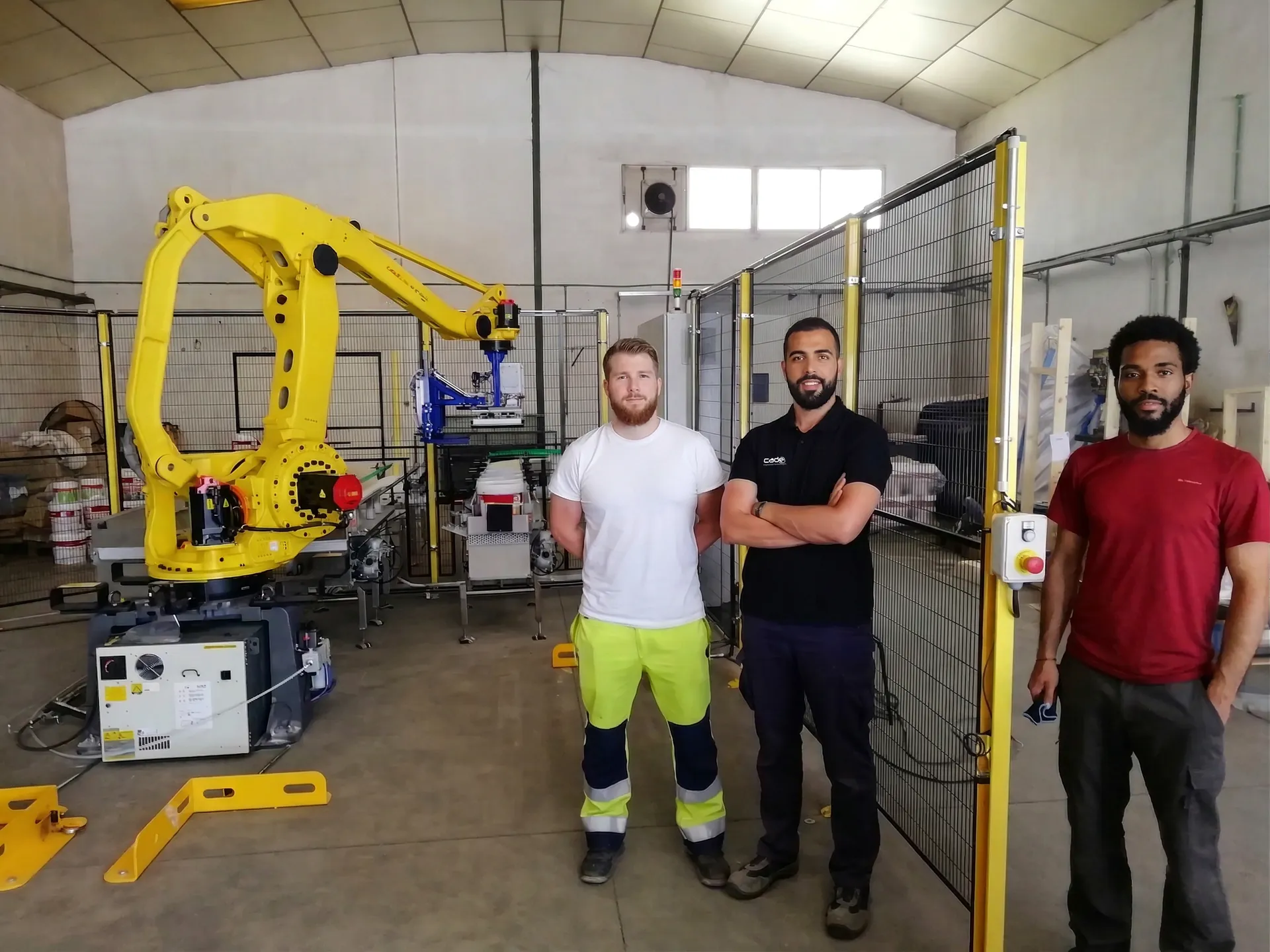
The automatic palletising cell developed by CADE was configured as a complete end-of-line system combining robotic handling, conveying, control and safety. At the core of the system was a FANUC M-410iC/185 industrial palletising robot, integrated within an enclosed cell and coordinated with the rest of the equipment to ensure continuous end-of-line operation.
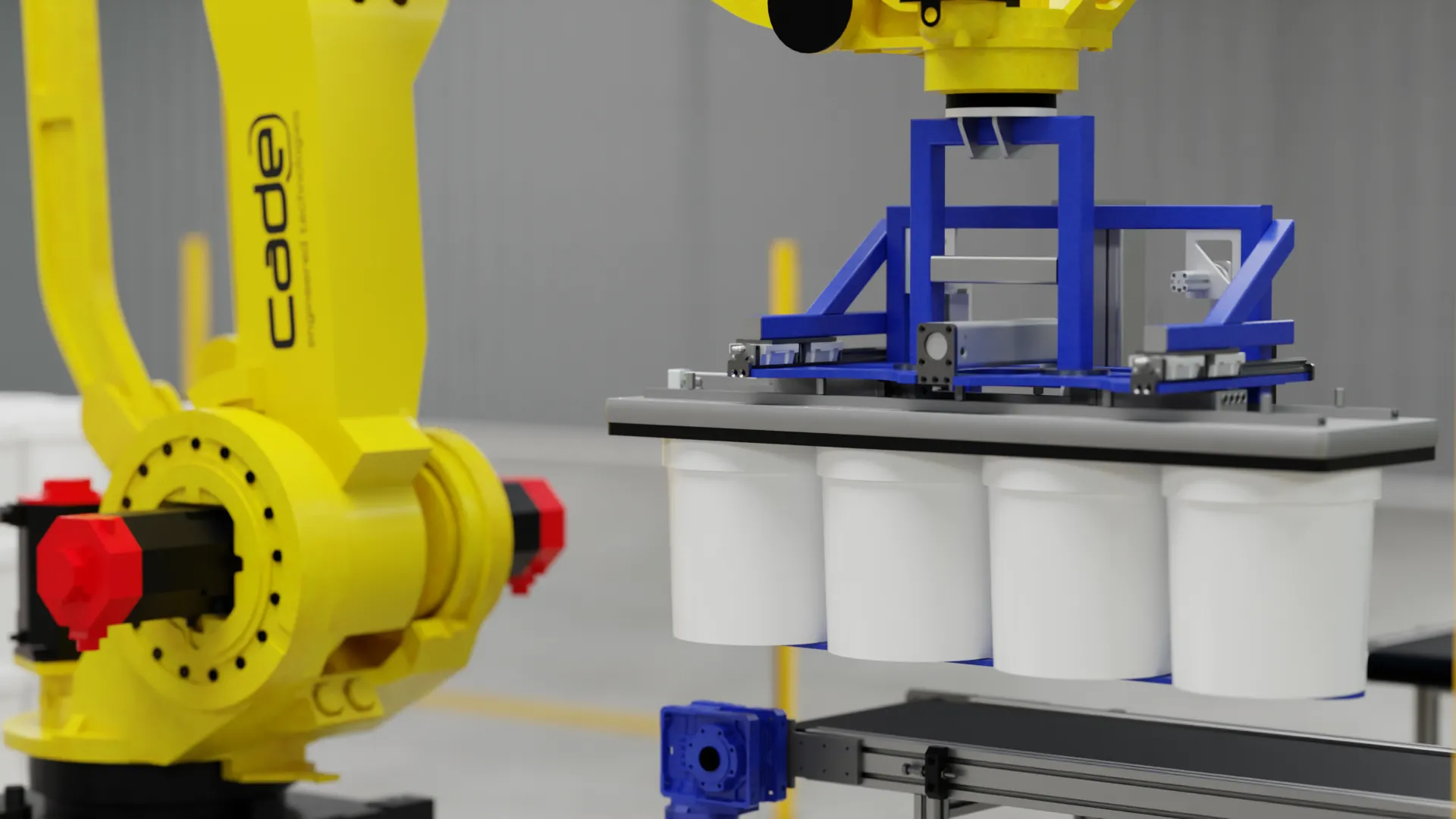
To guarantee reliable handling, a specific gripping system was designed, capable of working with the different can formats without the need for complex changeovers between references. This part of the solution was key to maintaining system versatility and ensuring stable picking, while minimising risks during movement and pallet placement.
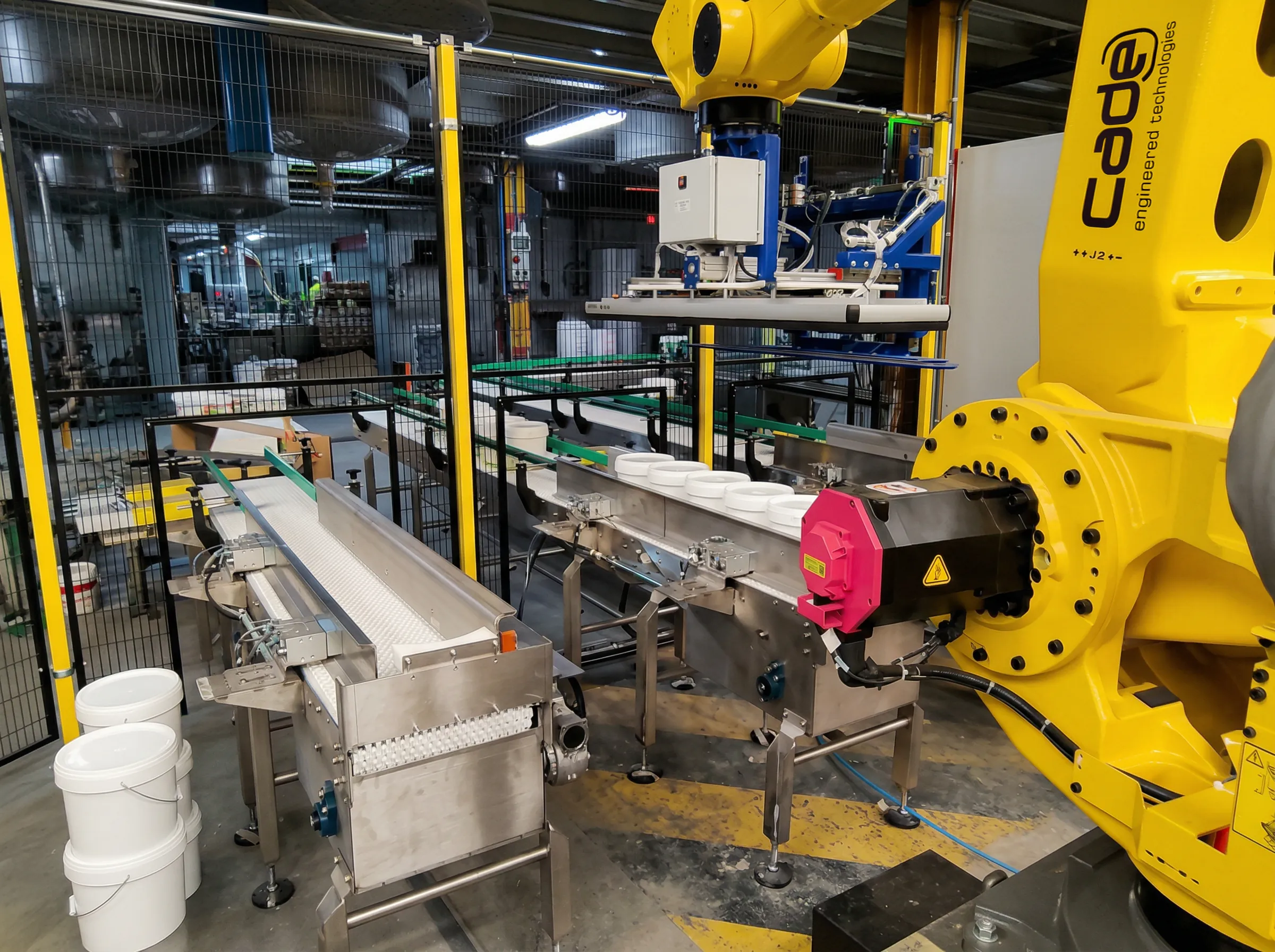
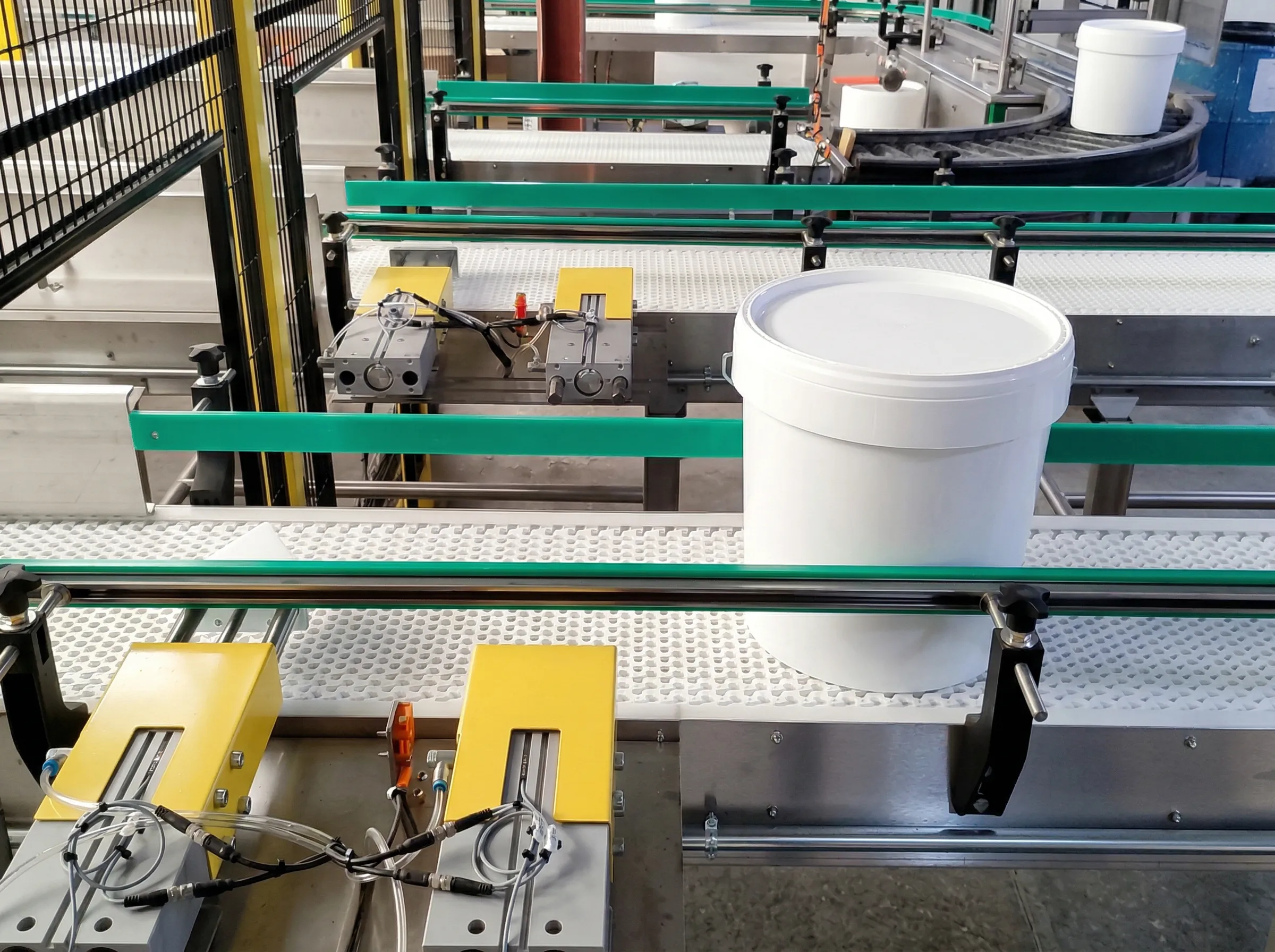
The installation was completed with a PLC-controlled roller conveyor system, allowing the product to be transferred from the packaging lines to the handling area under the right positioning and sequencing conditions. In addition, several palletising stations, detection systems, an operator control panel and a full set of protections and controlled accesses were integrated to ensure safe operation adapted to real plant requirements.
Beyond the robotic equipment itself, the CADE proposal was developed as a global solution in which mechanics, automation, control and safety work in coordination to turn the end-of-line into a more reliable, more orderly process, better prepared to sustain production pace.
CADE Solution
Results
With the automatic palletising cell in operation, the plant gains a more stable, repeatable and safer palletising process. Automating this stage helps improve outfeed flow organisation, reduce dependence on repetitive manual tasks and reinforce stability in pallet formation.
From an operational point of view, the installation delivers a more structured working environment, in which conveying, handling and palletising are integrated under one single control logic. This supports more continuous production, greater process repeatability and better management of an area that often concentrates manual effort and potential misalignments.
In addition, the solution strengthens key aspects such as safety, stacking uniformity and the ability to adapt to real plant operation. Overall, the project represents a tangible improvement in end-of-line automation, with a clear focus on industrial reliability and production continuity.
Describe your case and a CADE specialist will review it.
Other projects
- Piping and Ducts, Power Plants
- Ingeniería
- Smart Factories