

STS Crane Modernization
Structural innovation and FEM precision in port operations
Project description
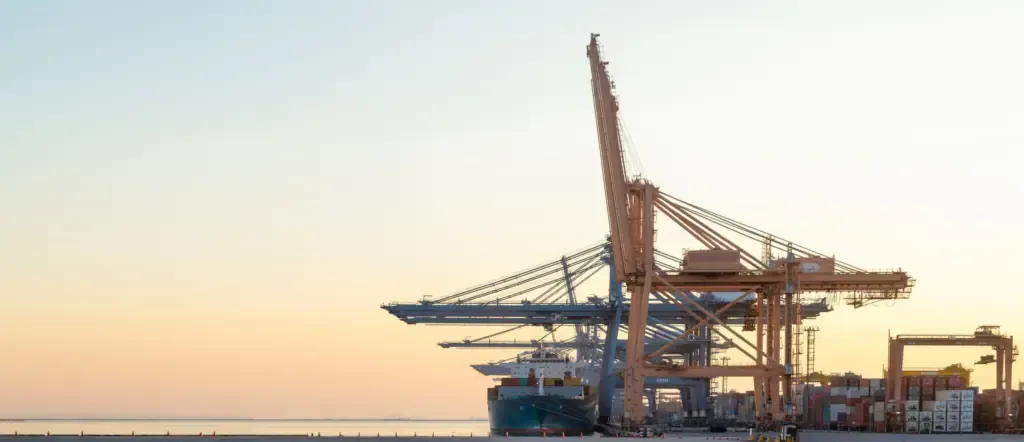
The modernization of STS (Ship To Shore) cranes is an advanced technical process aimed at upgrading and optimizing these structures, which are critical to port operations. This type of project focuses on extending the operating capabilities of the cranes, mainly to handle post-Panamax and ultra-large vessels efficiently, which require greater lifting height and outreach. Modernization combines high-precision structural engineering with innovative technology, including finite element analysis (FEA), global stability and local buckling calculations, and simulations of dynamic and static loads.
CADE has led several projects of this kind, with a constant commitment to technical excellence and innovation. CADE’s experience covers every phase of the process: from the initial assessment of the structures through visual inspection and non-destructive testing, to the design and 3D modelling of the required modifications. The solutions implemented by CADE include raising the main structure, reinforcing beams and columns, and optimizing the hoisting systems.
These projects use advanced technologies such as hydraulic jacking to lift the crane precisely, and the installation of permanent reinforcements to ensure stability and performance. Thanks to its experience and innovative approach, CADE has transformed port operations: the modernized cranes not only increase their operating capacity, but also work with greater efficiency, safety and reliability in a highly competitive environment.
Our technical capabilities
Finite Element Analysis (FEA)
Finite element models are used to simulate structural behaviour under different load conditions, assessing the distribution of stresses and strains.
Global stability and local buckling calculation
Axial forces and compressive stresses are calculated to ensure the structure does not suffer instability or buckling failure.
Reinforcement of portal beams and columns
Reinforcing beams are added and column stiffness is increased by welding additional material and reinforced flanges.
Hoisting system optimization
The rope drums are adjusted and new sheave systems are installed to suit the additional height, minimizing wear and optimizing the efficiency of operations.
Technical planning and phased execution
At CADE we follow a structured technical plan for STS crane modernization, designed to address each stage of the process comprehensively and efficiently. This organized approach sets out the phases needed to transform and optimize these structures, ensuring they meet the most demanding international safety standards and regulations.
From the initial assessment, with detailed inspections and analyses, to advanced design through 3D modelling and controlled execution with precise techniques such as hydraulic jacking, we deliver a robust and reliable result. Our plan ensures a modernization that optimizes operation, extends the service life of the cranes and improves their performance.
Structural assessment and code compliance
- Visual inspection and non-destructive testing: before any intervention, detailed inspections and tests such as ultrasonic and X-ray testing of critical welds are carried out.
- Analysis of the original loads: a complete structural analysis is performed to identify potential failure points under dynamic and static loads.
Modelling and design of the crane raising
- Parametric 3D modelling: a three-dimensional model including all the planned modifications is developed, and the maximum loads are simulated for each operating scenario.
- Reinforcement of beams and hoisting ropes: tensile loads on the ropes are calculated and reinforcements are designed for the upper beams to withstand the new operating height.
Execution and erection
- Jacking and lifting of the structure: a hydraulic jacking system is used to lift the crane in a controlled way. This process requires constant monitoring of the weight distribution and temporary reinforcements to prevent deformation.
- Installation of permanent reinforcements: additional beams are welded to the columns and flanges are added to improve stiffness. The anchor bases are adjusted to take the increased vertical loads.
Technical challenges
Raising STS cranes involves state-of-the-art technical advances to optimize their performance and adapt them to current demands. Highlights include precision jacking systems, which lift the whole structure in short times, such as 24 hours, with real-time monitoring through load sensors. This ensures the stability of the structure and avoids dangerous twisting or displacement.
Another key innovation is the boom extension to serve larger vessels. This requires recalibrating the angle of the forestays and redesigning components such as the trolley, ensuring the hoisting system can carry the new loads without compromising the durability of the mechanical components. These solutions reflect an advanced technical approach to today’s challenges in the port industry.
Describe your case and a CADE specialist will review it.
Other projects
- Piping and Ducts, Power Plants
- Ingeniería
- Smart Factories