
Water hammer is a pressure wave generated when a liquid moving through a pipe is suddenly stopped or accelerated. The wave travels along the line at high speed and causes overpressure or vacuum peaks that can damage valves, supports and equipment. Modeling it makes it possible to protect the plant before a failure occurs.
What is water hammer and what factors determine it?
- When the fluid stops suddenly, its kinetic energy is converted into pressure on the pipe walls.
- The size of this pressure peak depends mainly on the liquid velocity, its density and the stiffness of the pipe, the parameters in the Joukowsky equation (ΔP = ρ · a · Δv). For example, suddenly stopping water flowing at 2 m/s in a rigid pipe (wave speed a = 1,200 m/s) produces a sudden overpressure of about 24 bar.
- Mechanical design codes such as ASME B31.3 and B31.4, and water industry standards such as AWWA M11 (in their current editions), require these occasional transient loads to be considered so that the line keeps its integrity.
When can water hammer occur in your plant?
- Sudden pump trip caused by a power failure.
- Isolation, control or check valves closing too fast.
- Pump start-up with partially empty lines or trapped air.
- Sudden flow changes in process, cooling or firefighting networks.
What are its causes, consequences and usual solutions?
| Triggering event | What happens in the pipe | Consequence for the plant | Usual solution |
|---|---|---|---|
| Sudden pump trip | Sudden pressure drop followed by a return wave | Pipe rupture or violent slamming of check valves | Surge tank or bypass line |
| Rapid valve closure | Overpressure peak upstream of the valve and low pressure downstream | Support deformation, flange leaks or fitting failure | Adjust the closing curve or install a relief valve |
| Pressure falls below vapor pressure | Transient cavitation (vapor pockets form and collapse) | Vacuum collapse of the pipe or severe impact when the liquid column rejoins | ARV (air release and vacuum valve) |
Table 1. Causes, consequences and usual solutions for water hammer.
How is water hammer assessed?
- Physical model of the network: pipe lengths, diameters, wall thicknesses and materials are gathered to determine how fast the pressure wave will travel in each section.
- Normal operating conditions: flow rates, working pressures, pump curves and tank levels are defined before the event occurs.
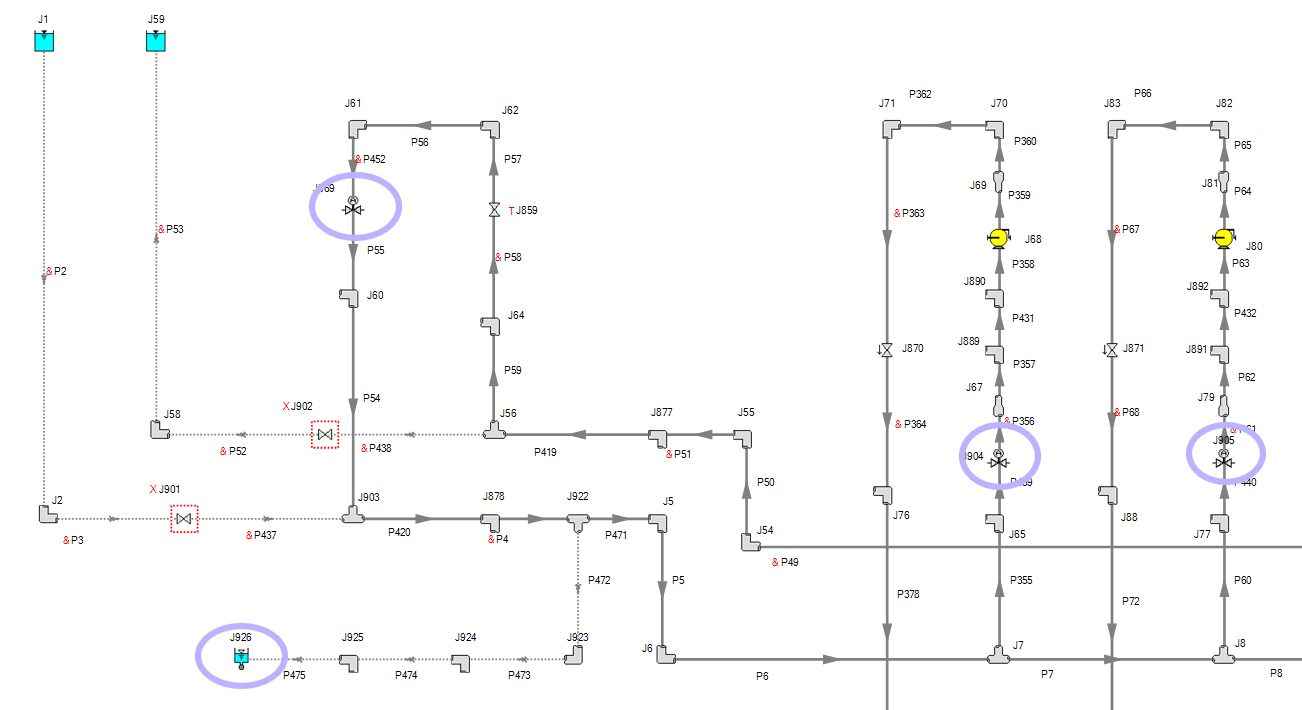
- Simulation of the critical scenario: the event (pump power failure or rapid valve closure) is reproduced mathematically to see how pressure and low-pressure waves evolve second by second.
- Sizing of protection devices: if the allowable limits of the pipe are exceeded or vacuum appears, devices such as surge tanks or ARVs are added and sized until the system is stable.
What if a hand calculation is not enough?
Hand calculations of water hammer often fall short in real plants. Those equations assume a straight pipe and an instantaneous closure, but in a plant the waves bounce off elbows, branches and equipment and add up in ways that are hard to predict.
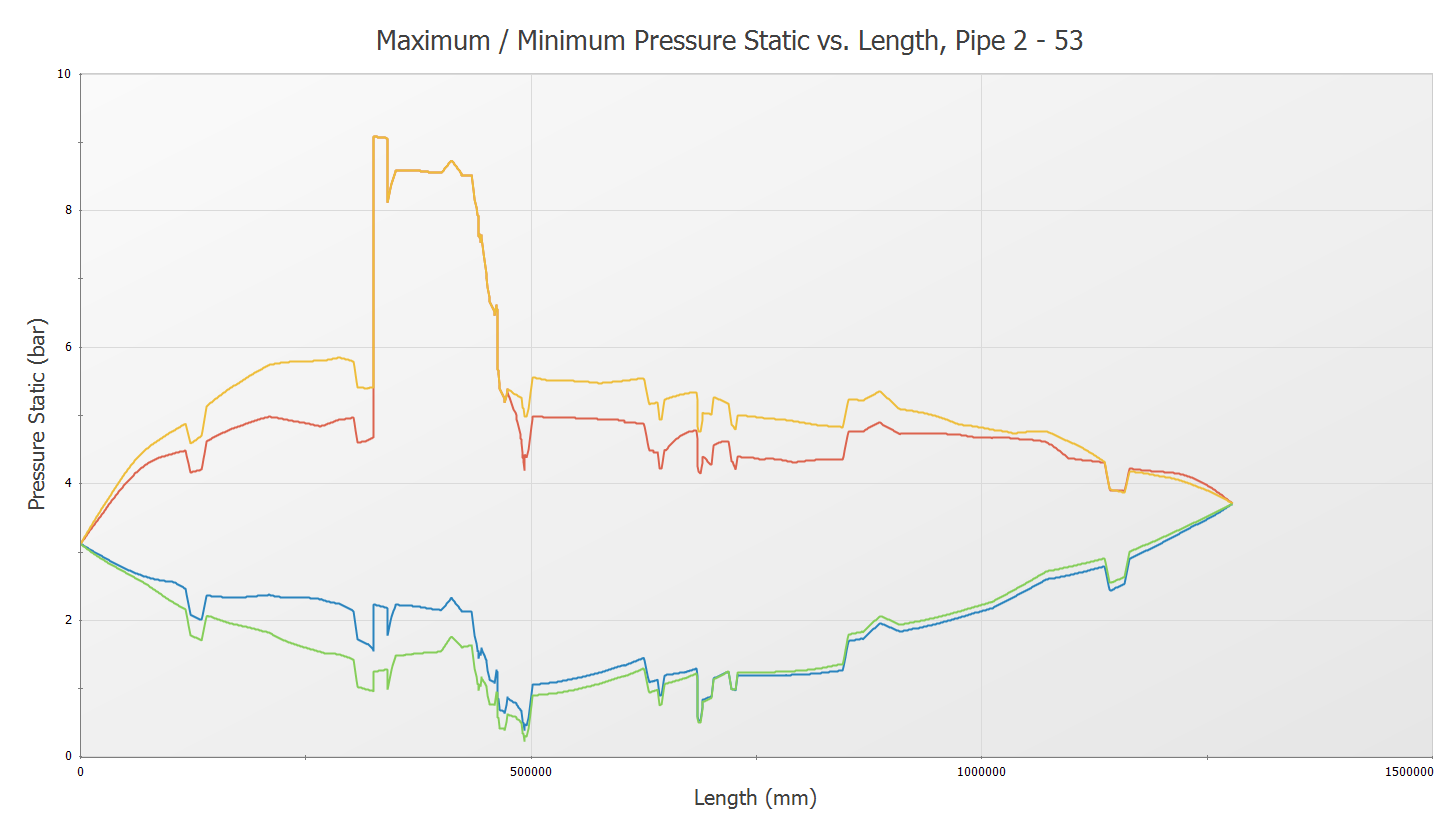
In addition, the greatest danger is not always the overpressure peak but the sudden pressure drop. If the line goes into vacuum, the liquid can vaporize and form vapor pockets that, when they collapse seconds later, cause very destructive impacts.
With transient hydraulic simulation we reproduce the full path of these waves over time. That way we check whether a pipe can collapse under vacuum and size a surge tank or an ARV accurately, without oversizing the plant.
Frequently asked questions about water hammer
How is water hammer calculated?
For initial estimates, the Joukowsky equation gives the maximum pressure surge assuming an instantaneous closure. In real networks, water hammer is calculated with the Method of Characteristics (MOC). This algorithm solves the fluid conservation equations step by step along the pipe and runs in transient simulation software.
What is an ARV?
An ARV is an air release and vacuum valve. During a hydraulic transient, its main job is to let air into the pipe immediately if the line drops into vacuum, so that the pipe does not collapse.
What is the difference between water hammer and cavitation?
Water hammer is the mechanical wave caused by a sudden stop of the fluid. Cavitation is a consequence of that wave: it occurs when the low-pressure phase drops below the vapor pressure and the liquid vaporizes. When those vapor pockets collapse, they cause the most destructive impacts.
Talk to our Engineering and Consulting team
If you notice pipe vibration or banging when pumps stop, or you are about to modify a pumping system, it is worth checking its transient behavior before operating. At CADE we carry out these dynamic studies with specialized software such as AFT Impulse to define protection tailored to each network. You can see the scope of our services in Engineering and Consulting.
Related CADE services: Engineering and Consulting · Piping design and stress analysis · CFD simulation
You may also like: When to perform a water hammer analysis? · ASME B31.12: flexibility analysis of hydrogen piping · GRP/FRP pipelines: piping flexibility calculations