
In pressure vessel and tank fabrication, piping and structural steelwork, the part that reaches the welding cell rarely matches the drawing to the millimetre. Cutting tolerances, root gap variation, fit-up misalignment and thermal distortion are part of everyday life on the shop floor. CADE SRW (Smart Robotic Welding), the intelligent robotic welding solution developed by CADE, starts from that reality: instead of requiring every part to be identical, it adapts to each one as it welds.
What is CADE SRW?
CADE SRW is an intelligent robotic welding solution able to recognise the joint, interpret the real geometry of the part and adjust the process during operation. This makes it possible to automate complex work, reduce variability, improve weld quality and bring greater stability to demanding industrial environments.
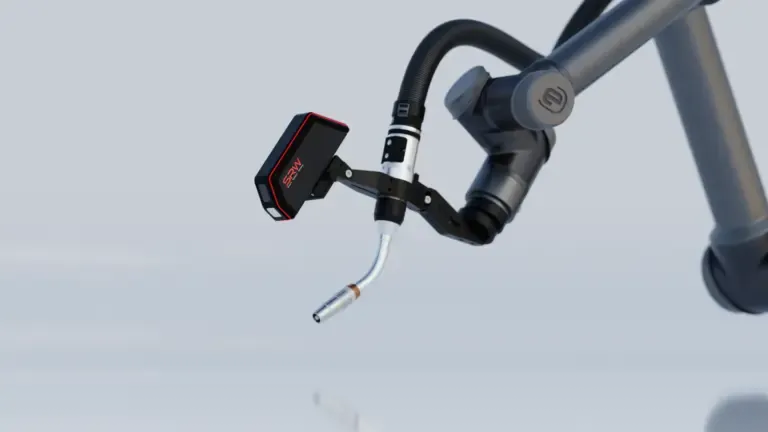
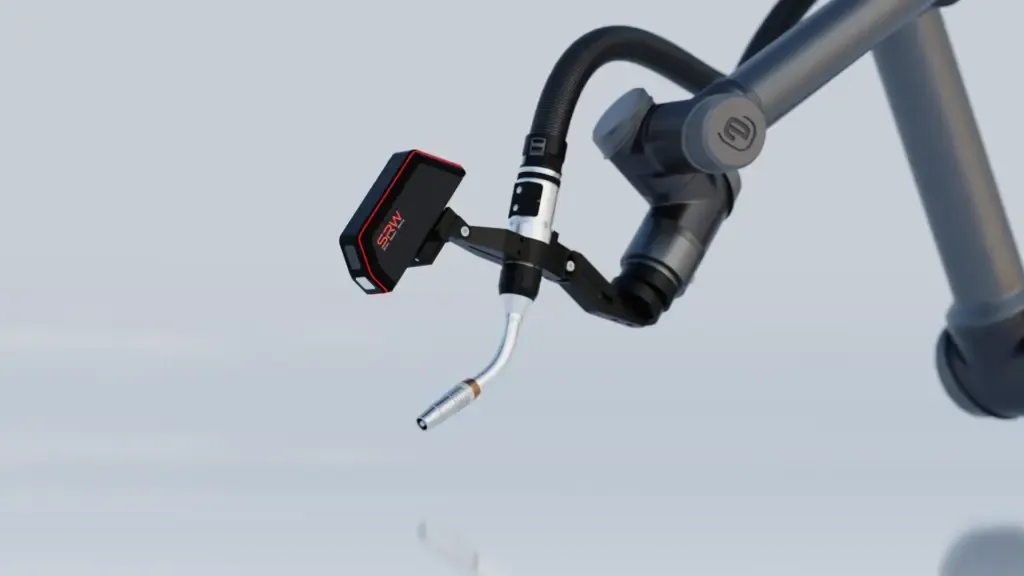
The system combines a robotic arm with 3D machine vision and adaptive control of the process. It locates the joint, tracks it in space and adjusts the torch stand-off, the torch angles and the welding parameters in real time, much as a qualified welder would.
Its value lies in the perception and control layer: this is what makes it possible to automate joints that, with conventional programming, would still depend on manual welding.
Why the real part does not match the drawing
A conventionally programmed welding robot repeats a taught path with great precision. The problem arises when the part is not exactly the one used to program it. In metal fabrication, that difference is common:
- Cutting and forming tolerances.
- Root gaps and misalignment (hi-lo) at fit-up.
- Geometric variations between units of the same series.
- Distortion caused by the welding heat input itself.
If the joint shifts by a few millimetres, the conventional robot keeps welding where it expected it to be. The result is off-seam weld beads, rework and, in many cases, the decision not to automate. CADE SRW was created to work precisely in that space: taking robotic welding towards a more intelligent, precise and adaptable model.
How CADE SRW works
The process is organised in three phases:
Calibration
The system determines the relative position between the sensor and the torch (tool centre point).
Seam finding
It locates and detects the joint on the real part.
Seam tracking
It tracks the joint in 3D, maintains the torch stand-off and angles and corrects deviations along the entire path.
From the detected geometry, CADE SRW generates the path automatically, with its orientations and waypoints, without depending on rigid programming. That is why it can adjust circular or longitudinal paths without reprogramming the robot for each part.
3D machine vision and adaptive control
Depending on the application, the system’s perception combines a laser line profile sensor and an optical camera. This combination makes it possible to work with shiny surfaces, reflections and different types of material.
Adaptive control acts on that information:
- Thickness. It adjusts arc power, travel speed and weaving to achieve uniform penetration and a consistent bead profile.
- Torch angle. It maintains the optimum work and travel angles on curved seams, cone-to-cylinder joints and thickness transitions.
- Distortion. It corrects the path, the torch angles and the welding parameters when the part moves during welding.
In certain structural steel applications, CADE SRW reaches travel speeds of up to 1 m/min, while maintaining process stability and bead quality. See all capabilities.
Welding processes and joint types
CADE SRW is compatible with different welding processes, such as MIG/MAG (GMAW), TIG (GTAW) or laser welding, which are controlled from a single interface with preconfigured parameters.
It works with butt, fillet and lap joints, and with longitudinal seams, circumferential (girth) seams and orbital welds. On pipes and shells it covers from 6″ pipe to large-diameter shell courses.
Applications of intelligent robotic welding
CADE SRW’s natural field is metal fabrication in which geometric variability or joint complexity have made automation difficult.
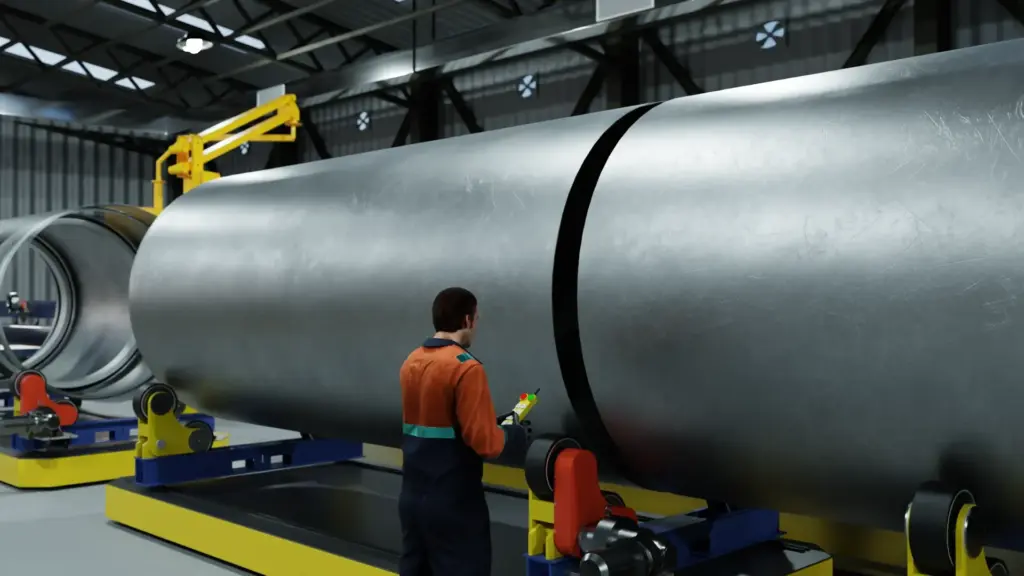
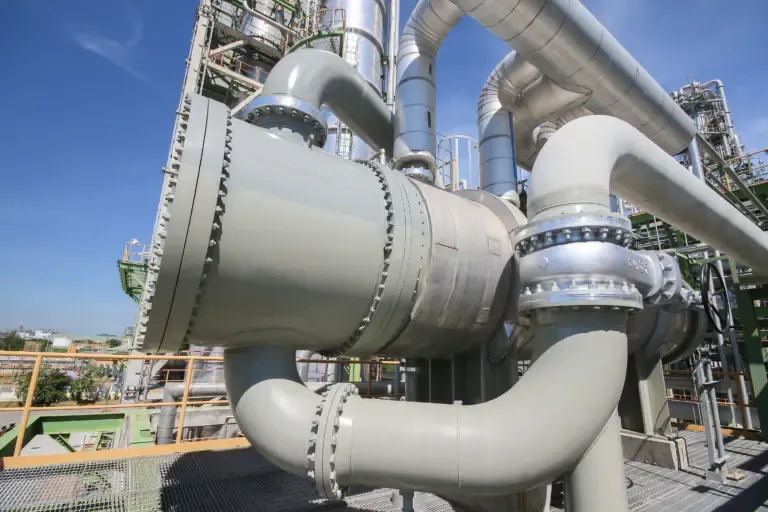
Vessels and tank fabrication
Shell courses, heads and covers for industrial tanks and vessels, with uniform longitudinal and circumferential seams. Long tanks for transporting or storing fluids, light plate fabrications such as casings and enclosures, and stainless steel or aluminium equipment that requires precise control of heat input. Also compact industrial modules and auxiliary equipment for process plants. More about vessels and tank fabrication.
Pipes and ducts
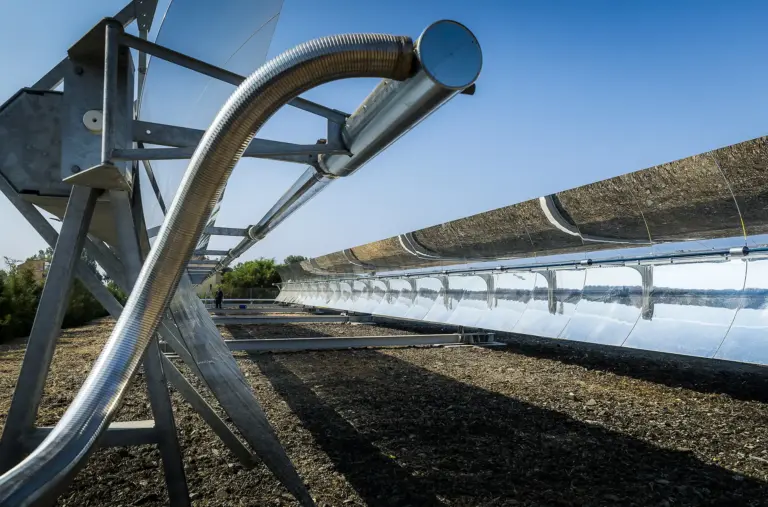
Industrial service piping for air, water, steam or vacuum; ventilation and extraction ducts of circular or rectangular section; pipe spools and light prefabricated assemblies; headers and branch connections, and food or chemical process lines in thin-walled stainless steel. In stainless, carbon or galvanised steel pipes and ducts from 1 to 10 mm thick, adaptive control compensates for ovality, minor hi-lo misalignment and wall thickness variations. More about pipes and ducts.
Structural steelwork
Light frames and chassis, support structures and racks, precision frames, sheet metal casings and covers, modular structures for series assembly and large structures such as plate girders, stiffening rings and large-format frames. More about structural steelwork.
Traceability: every bead, recorded
CADE SRW records in real time the position, welding current, travel speed, temperature and path of every weld. That information can be integrated with MES or SCADA systems for process analysis, predictive maintenance and quality audits.
Welding stops being a black box and becomes a measurable process.
What it brings to production
- Precision, stability and repeatability between beads and between units.
- Less variability and more consistent bead quality.
- Less distortion, less rework and less set-up time.
- Less operator exposure in hard-to-reach areas and confined spaces.
- Stronger quality control thanks to digital traceability.
CADE's approach
CADE SRW is an in-house development by CADE, an engineering company based in Albacete, Spain. The technology is developed at CADE’s Innovation Factory, where welding engineering, robotics and machine vision work on real parts and real manufacturing conditions.
The starting point is simple: to automate welding, the robot has to understand the part in front of it. CADE holds ISO 9001, ISO 14001 and ISO 56001 (innovation management) certifications.
From the real joint to automated welding
Recognise the joint. Interpret the part. Adjust the process. Record every bead.
This is how CADE SRW brings robotic welding to parts that until now resisted automation.
If you would like to see CADE SRW working on your own parts, you can request a demonstration from our team.