
Advanced studies on material behaviour and fracture mechanics focus on assessing how the level of triaxiality, or constraint, influences the onset of fracture.
From a local analysis standpoint, high levels of triaxiality (constraint) can lead to ductile fracture driven by enhanced microvoid growth and coalescence (MVC), which eventually develops into cracks.
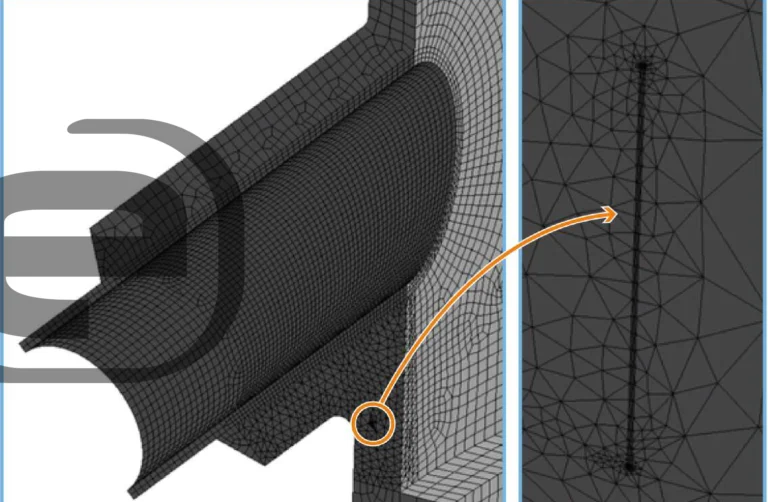
This analysis method makes it possible to predict crack initiation in the weld from the stress state, the equivalent plastic strain and the triaxiality level. The analysis is carried out with the finite element method using the commercial software ANSYS.
Triaxiality is defined as the ratio of the mean (hydrostatic) stress to the von Mises equivalent stress, so a triaxiality level can be assigned to any stress state. The relationship between these parameters and crack prediction is established through the requirements of API 579/ASME FFS-1 “Fitness-For-Service”, by determining a limiting triaxial strain εL, which depends on the uniaxial strain limit εlu, the strain hardening parameter m2, the material factor for the multiaxial strain limit αsl and the triaxiality level of the element, according to the following equation:

Crack initiation is predicted when the calculated equivalent plastic strain εcal exceeds the limiting strain εL:
εcal > εL
It can therefore be concluded that, for the same strain state, triaxiality has a marked effect on crack initiation: elements with high triaxiality levels are more prone to cracking. This makes it possible to predict cracks even at relatively low strain levels that conventional analysis methods would not have detected, and likewise to rule out cracking in elements with large strains but low triaxiality.
On the other hand, from a global behaviour standpoint, brittle fracture may be caused by cleavage, whose occurrence is also governed by high levels of triaxiality.
This analysis methodology, based on the assessment of triaxiality levels, is the preliminary stage of the fracture evolution study, in which the crack is modelled geometrically (size, shape and position) and fracture mechanics theories are applied.
CADE applies this methodology to weld analysis as a tool to detect in-service failures, or during the early design stages, in welds whose size prevents assessment with traditional methods. In addition, the simulation tools used make it possible to approach the analysis not only from a structural standpoint but also by integrating several disciplines, so that the weld is also analysed from a thermal/microstructural standpoint to characterise its behaviour as faithfully as possible.
Related CADE services: Engineering analysis and consultancy services · Welding Engineering
Further information: American Petroleum Institute (API)