
Introduction
Energy Storage: Massive Deployment of Renewable Energy and Industrial Decarbonization.
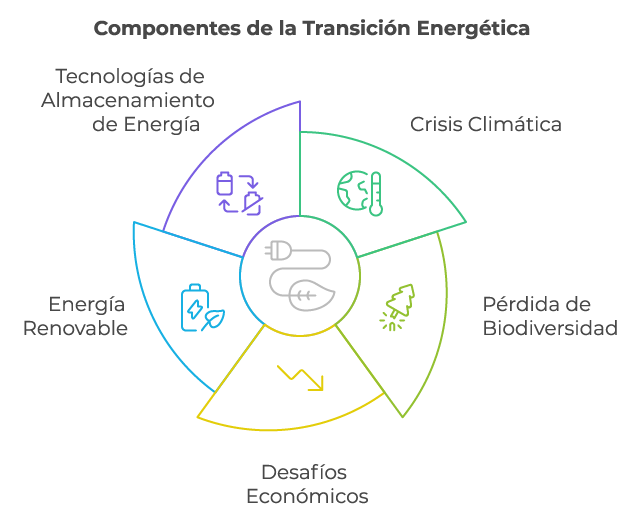
The climate crisis, biodiversity loss and economic challenges have led to growing public awareness of the climate emergency and to the launch of actions aimed at reversing the trend of the complex set of problems that has arisen. Although there is considerable reluctance in certain economic and social sectors, there is a global consensus, both in the scientific community and among most states, on the need to implement urgent measures to reverse the devastating consequences that are beginning to be clearly felt.
In the decarbonization of industries with massive energy consumption, renewable energy plays a central role. However, its intermittent nature creates the need for energy storage systems so that, during periods of low or zero generation, the continuous supply that demand may require is available. The development of storage technologies thus becomes a fundamental pillar of the energy transition and a cornerstone in the deployment of renewable generation plants as a viable solution for them to gain an ever greater share of the energy mix, even when they are medium-sized and highly distributed.
Another issue is that renewable generation systems have serious impacts on the power grid, such as variations in the magnitude of the supply voltage and an increased imbalance between the active and reactive power of the interconnected generation sources. The lack of automated management tools, together with penalties for imbalances in the day-ahead market, undermines the economic competitiveness of renewable energy in the energy market. Energy storage systems are therefore established as a technological solution for the controllability of renewable energy, acting as a grid-stabilizing element that balances supply and demand and enables its participation in the daily energy market.
In this context of energy transition, storage is one of the challenges we must address to achieve the complete decarbonization of the energy system and the effective integration of renewable technologies. The partial predictability and variability of these technologies make it essential to have systems that can bridge instantaneous gaps between generation and demand. These systems must be able to store energy during periods of surplus generation so that it is available when shortfalls occur.
a) Background.
In 2015, all United Nations (UN) Member States adopted 17 Sustainable Development Goals (SDGs), alongside the COP21 Paris framework, setting out a plan to achieve these goals within 15 years (the 2030 Agenda for Sustainable Development). The SDGs are a universal call to action to end poverty, protect the planet and improve the lives and prospects of people everywhere. They are interrelated and incorporate the global challenges we face every day, such as poverty, inequality, climate, environmental degradation, prosperity, peace and justice. In short, they are the blueprint for achieving a sustainable future at a global level.
Taking the 2030 Agenda as its guiding thread, the European Union (EU) has set a series of strategic objectives to transform the region into a more sustainable, green and equitable economy. Regulation (EU) 2021/1119 of the European Parliament and of the Council of 30 June 2021 establishes the European Commission’s strategic framework for meeting environmental, energy and climate objectives by 2050, the so-called EU 2050 Plan, which seeks climate neutrality by that year. The recitals of the regulation set a binding objective of achieving a climate-neutral economy through the progressive and irreversible reduction of anthropogenic greenhouse gas (GHG) emissions and the enhancement of removals of these gases by sinks regulated under Union law. Ultimately, this promotes a more sustainable economy, in both production and consumption, through a gradual decarbonization process that will bring energy independence from fossil fuels.
The pursuit of climate neutrality is also in line with the EU’s commitment to global climate action under the Paris Agreement. For this reason, EU Member States have developed long-term national strategies on how they plan to achieve the GHG emission reductions needed to meet their commitments under the Paris Agreement and the EU’s climate neutrality objective. The EU submitted its long-term strategy to the United Nations Framework Convention on Climate Change (UNFCCC) in March 2020.
In addition, the long-term strategies must be consistent with the National Energy and Climate Plans (NECPs) that Member States have established for the 2021–2030 period.
At the national level, Spain has set its own strategic framework through its NECP (PNIEC). This plan, aligned with EU guidelines, sets specific targets for reducing emissions, incorporating renewable energy sources and improving energy efficiency. Spain’s NECP seeks not only to contribute to meeting European commitments, but also to seize the economic opportunities associated with the transition to a digitalized, low-carbon economy. Diversifying the energy mix, promoting sustainable mobility, renovating buildings and modernizing industry are some of the fundamental pillars of the Spanish NECP.
In short, both the EU 2050 Plan and Spain’s NECP reflect a shared sense of urgency and determination to tackle climate change. These initiatives are not only a strategic response to environmental challenges, but also an opportunity to redefine and strengthen the foundations of long-term prosperity and well-being.
The transition to climate neutrality before 2050 entails a profound transformation of the system, which will be powered mainly by renewable resources. However, the variable and stochastic nature of some of these energy sources makes it necessary to have various tools that provide flexibility to the system, which necessarily involve digitalization and energy storage itself. The central idea, therefore, is to be able to store production surpluses as efficiently as possible and to automatically control the entire energy generation, transmission and distribution network using Artificial Intelligence (AI) tools.
Related CADE services: Thermal Storage · Industrial Decarbonization
Further information: International Energy Agency (IEA)