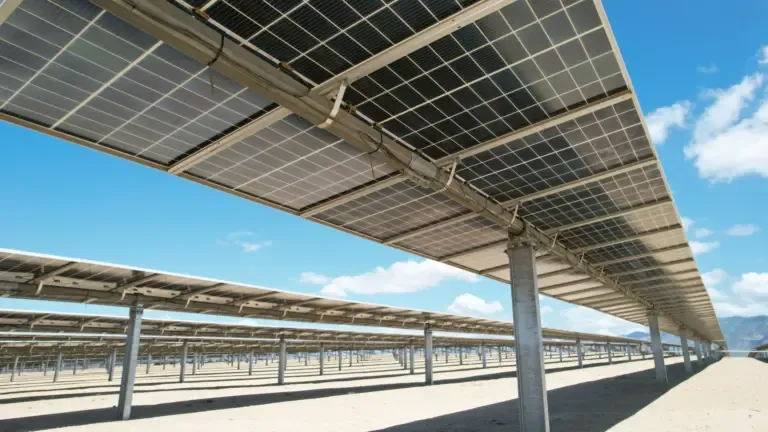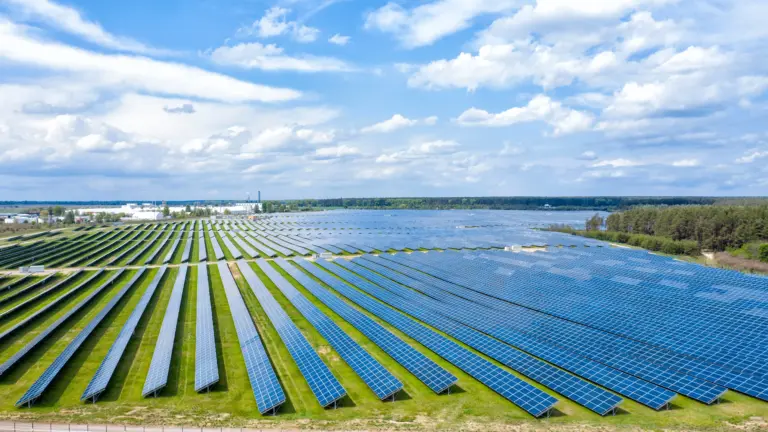
The structural analysis of photovoltaic plants must start from the fact that the behavior of each structure depends on many factors: wind, snow, terrain, foundations, connections, assembly tolerances and, in the case of solar trackers, also the tracking strategy and dynamic and aeroelastic phenomena.
When a solution is replicated across hundreds or thousands of structures, small deviations in design, manufacturing or execution can become significant problems for the asset as a whole.
For this reason, the structural engineering of a photovoltaic plant should not be limited to checking profiles and foundations. It is necessary to understand how the complete system works, which assumptions drive the design and where its critical failure modes lie.
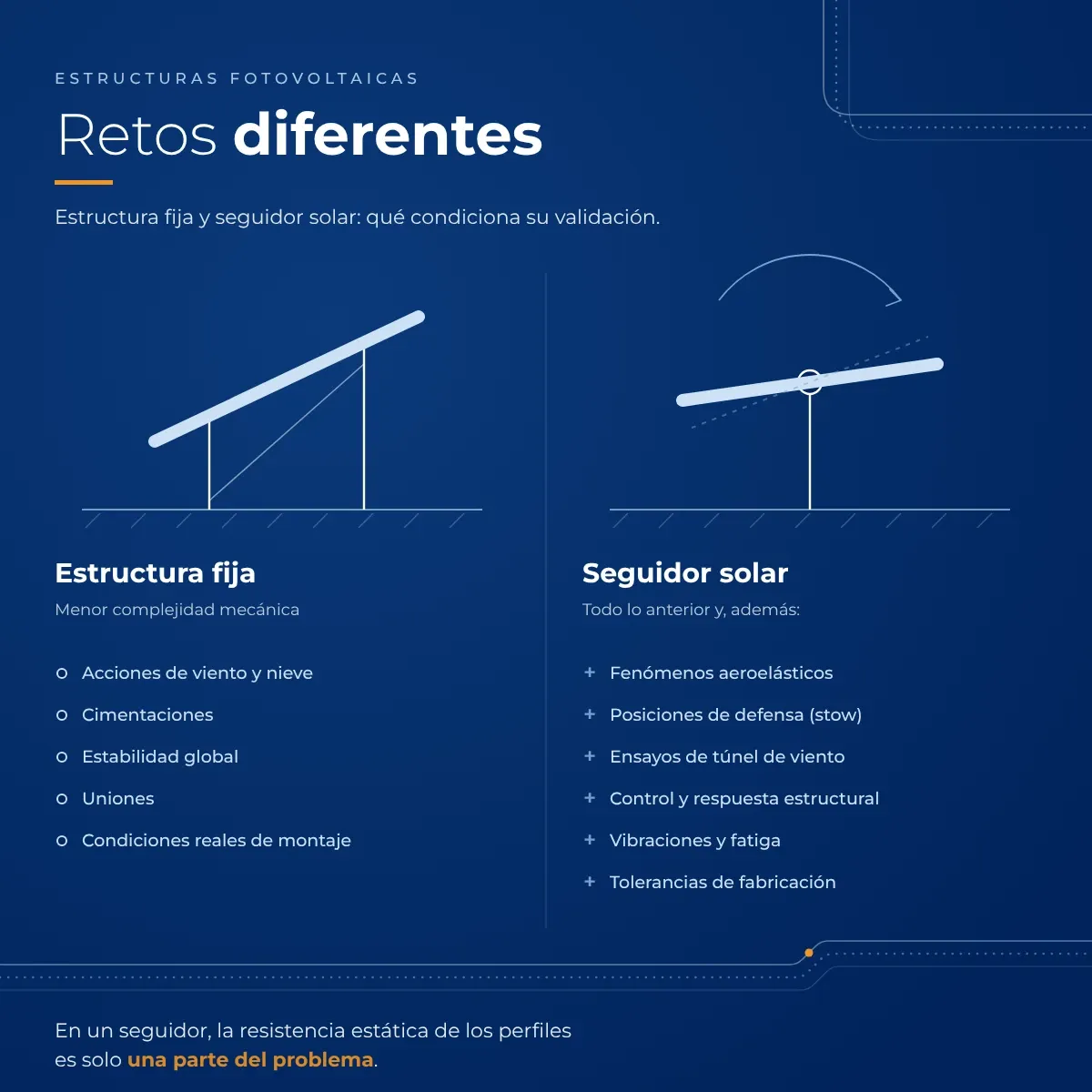
Fixed structures and trackers: different challenges
Fixed structures are mechanically less complex, but their validation still depends on a correct definition of wind and snow actions, foundation behavior, global stability, connections and actual assembly conditions.
Solar trackers add further variables. Their flexibility, the large surfaces exposed to wind and the presence of moving parts mean that certain phenomena can become critically important.
These include:
- Aeroelastic phenomena and dynamic instabilities.
- Incorrect definition of wind stow positions.
- Inadequate interpretation of wind tunnel tests.
- Interaction between the control strategy and the structural response.
- Stress concentrations and local yielding.
- Vibrations and fatigue damage.
- Deviations associated with manufacturing, tolerances or assembly.
In these cases, the static strength of the profiles is only one part of the problem.
Where do risks arise in the structural analysis of photovoltaic plants?
Many structural problems do not stem from a single error, but from the combination of several assumptions or seemingly small deviations.
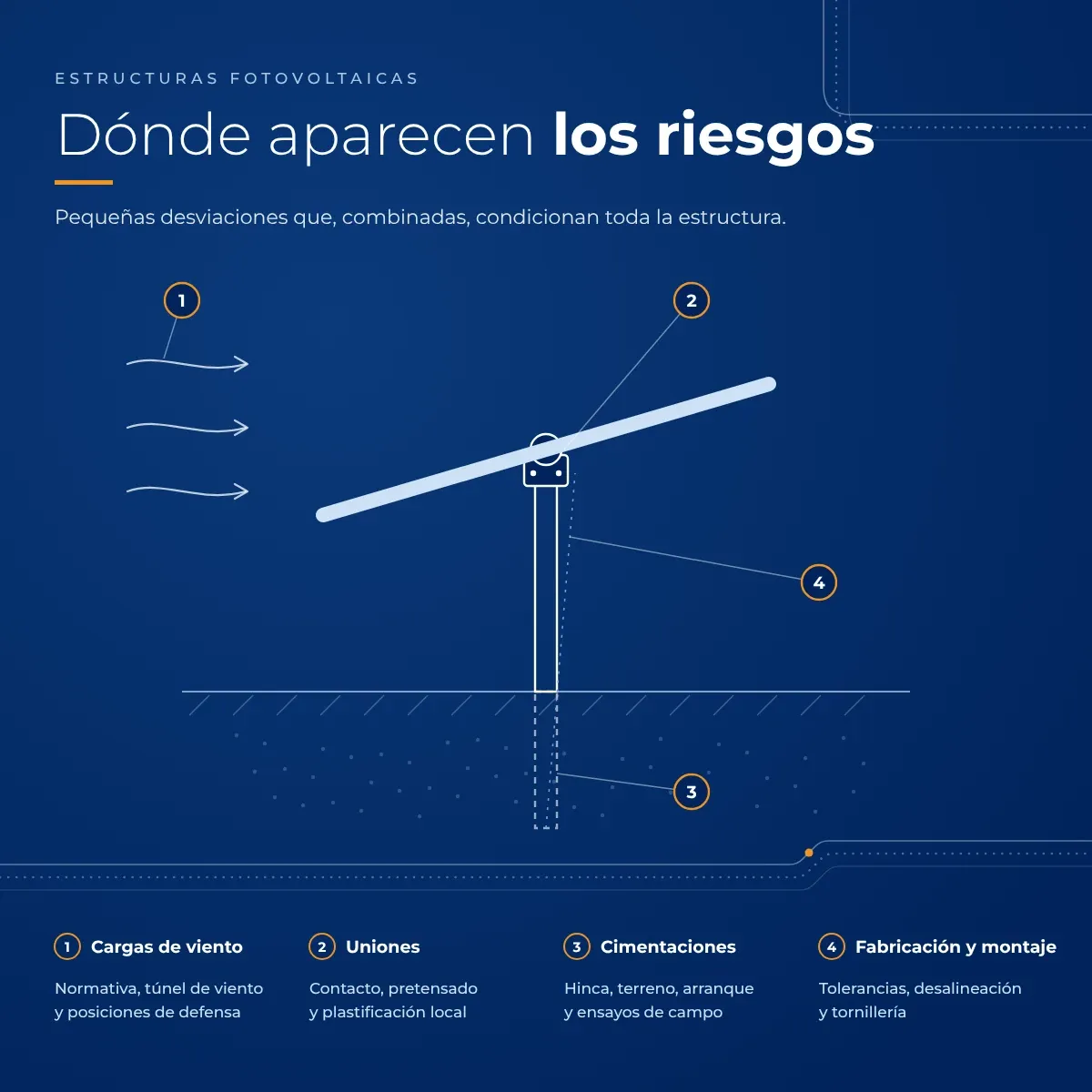
Wind loads
An incorrect interpretation of the design codes, the geographic coefficients or the wind tunnel tests can carry over directly into the sizing of the entire structure.
Trackers also require specific attention: as structures that are highly sensitive to aeroelastic phenomena, it is essential to assess their dynamic behavior and verify the suitability of their wind stow positions.
Connections and detailed models
Connections are usually one of the critical points of the design.
Oversimplified calculation models may fail to correctly represent phenomena such as contact between components, bolt preload, slip, local yielding or load redistribution.
When the connection governs the behavior of the system, detailed finite element models (FEM) make it possible to study mechanisms that can hardly be captured by a global model.
Foundations and ground
The capacity of the structure cannot be separated from the response of its foundations.
Pile driving depth, geotechnical properties, lateral stiffness, pull-out capacity, installation quality and ground variability can significantly modify the structural response.
The correct definition and interpretation of field tests is therefore essential.
Manufacturing and assembly
A correctly calculated structure can also present problems if the as-built reality departs from the design assumptions.
Misalignments, accumulated tolerances, incorrectly installed bolting, component changes or geometric deviations can introduce additional loads.
For this reason, when necessary, the analysis must consider the structure as actually installed and not only the original theoretical model.
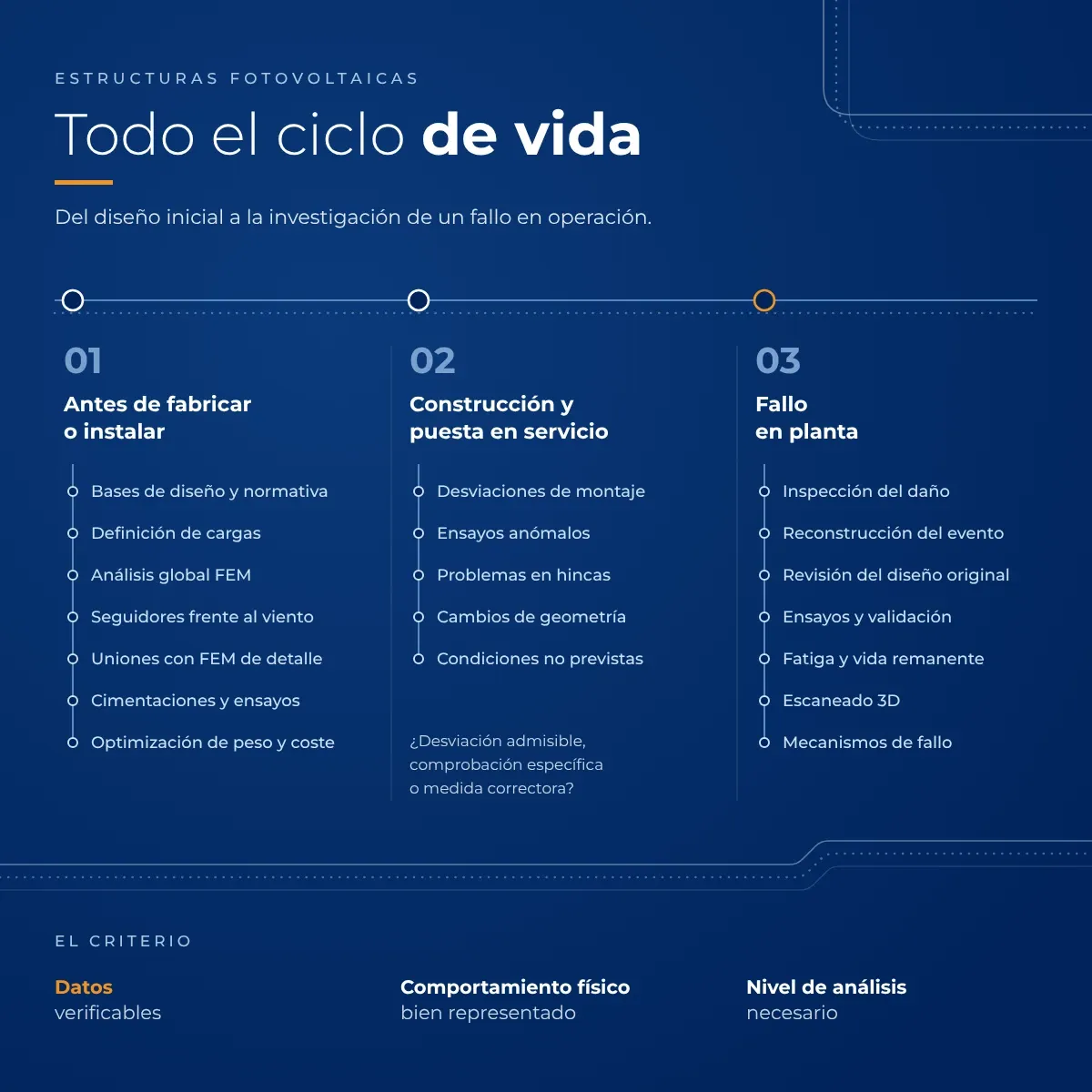
Engineering throughout the asset life cycle
At CADE we work on photovoltaic structures in the different phases of the project.
Before manufacturing or installation
For manufacturers and owners we carry out the structural review and validation of the design before its industrialization or deployment.
The work may include:
- Review of design bases and codes.
- Definition and verification of loads.
- Global FEM analysis.
- Assessment of stability and nonlinear behavior.
- Analysis of trackers under wind.
- Verification of profiles and components.
- Detailed FEM models of connections.
- Review and design of foundations.
- Assessment of field tests.
- Optimization aimed at reducing weight, complexity or cost.
The aim is not only to determine whether a structure complies, but to know its margins, identify which components govern the design and find real opportunities for optimization.
During construction and commissioning
In this phase, discrepancies may appear between the design and the installation as executed.
Engineering makes it possible to assess assembly deviations, anomalous test results, problems with driven piles or foundations, geometry changes or conditions not initially foreseen.
Based on this analysis, it can be determined whether a deviation is acceptable, whether it requires a specific check or whether a corrective measure must be adopted.
When a failure occurs on site
When a structure has already suffered deformations, fractures, foundation problems or damage during a weather event, the approach changes: “what has really happened and what does it imply for the rest of the plant?”
In these cases we carry out root cause analysis, depending on the problem:
- Inspection and characterization of the damage.
- Reconstruction of the event conditions.
- Review of the original design.
- Foundation analysis.
- Testing and experimental validation.
- Fatigue and remaining life analysis.
- 3D scanning.
- Assessment of failure mechanisms.
The aim is to distinguish the observed damage from its cause and define technically justified corrective measures before extending them to the whole plant.
Independent review and technical support
This methodology can also be applied as an independent review for owners, manufacturers, funds, insurers or third parties that need to know the structural risk associated with an asset.
CADE provides support in:
- Third-party review and due diligence: independent review of the design, calculation assumptions, tests and technical documentation.
- Root cause analysis (RCA) and expert witness support: investigation of failures, damage during extreme events and technical support in claims or litigation.
- Integrity and remaining life: assessment of existing structures, fatigue, degradation and residual capacity.
- Structural optimization: review of profiles, components and connections to reduce material or cost while maintaining the design requirements.
- Verification and validation (V&V): definition of tests and correlation between models and real behavior.
- Monitoring and digital models: strategies for monitoring the structural behavior of the asset.
Experience applied to real decisions
With nearly 25 years of experience in engineering and structural analysis, CADE has developed in-depth knowledge of photovoltaic structures: trackers, fixed structures and their foundations.
This allows us to approach a photovoltaic structure from different perspectives: as designers, as independent reviewers and as specialists who must reconstruct the behavior of a structure after a failure.
The methodology changes depending on the problem, but the criterion is the same: start from verifiable data, correctly represent the physical behavior of the structure and apply the level of analysis needed to reduce technical uncertainty before making a decision about the asset.
From the initial design of a structure to the investigation of a failure in an operating plant, the aim is to help manufacturers and owners make technically sound decisions on safety, reliability, cost and service life.
Do you need a structural analysis of photovoltaic plants or an independent review of your design? Talk to our team.