In solar PV structural engineering, the growth of solar PV has driven the development of larger plants with lighter, more efficient structures. This optimization process means that certain aspects of structural design, such as wind loads, dynamic behavior, connections, foundations or soil-structure interaction, have an ever greater influence on the reliability of the asset.
At CADE, we have spent years focused on solar PV structural engineering: analyzing how PV structures actually behave and helping manufacturers, owners, developers, insurers and expert witnesses make technical decisions on an independent structural basis.
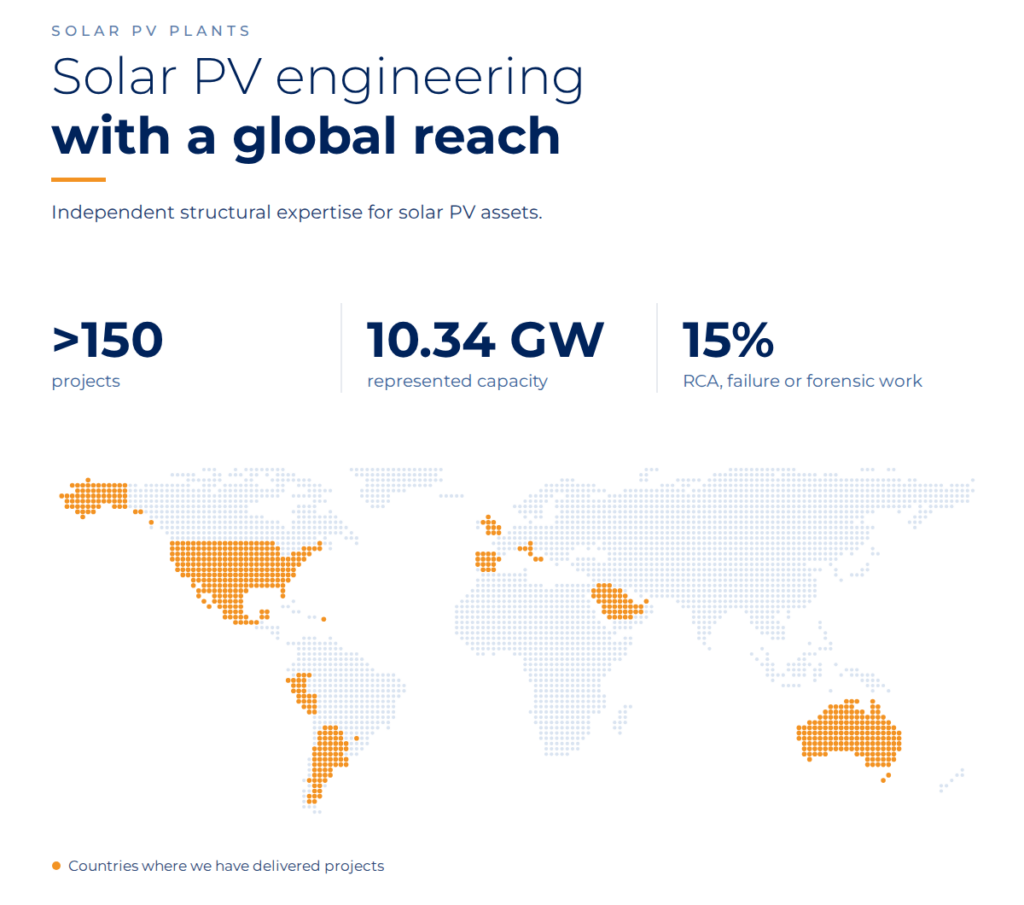
Our track record in solar PV structural engineering currently spans more than 150 projects, representing close to 10.3 GW of installed capacity.
But the size of the projects is only part of the story. What best reflects our work is the variety of problems we come across.
From Spain to the Middle East, Australia and the Americas
Most of our experience is concentrated in Europe, with some 5.6 GW of installations represented in our project database. Spain accounts for approximately 4.6 GW, with work on numerous plants across much of the Iberian Peninsula.
We have also worked in Italy, Portugal and the United Kingdom, among other European markets.
Outside Europe, the Middle East is a particularly significant part of our experience. Our work on large plants in the United Arab Emirates and Saudi Arabia represents around 4.1 GW, including large-scale projects such as Al Dhafra and Jeddah.
Our experience is completed by projects in Australia and several countries in the Americas, including Argentina, Mexico, the United States, Peru and Puerto Rico.
This geographic diversity matters from a structural point of view. A solar PV plant cannot be analyzed solely on the basis of its installed capacity or the tracker model used. Wind, snow, seismic conditions, topography, geotechnical characteristics and applicable codes vary substantially from one site to another.
Validating a solar tracker means analyzing the whole system
In solar PV structural engineering, one of CADE’s main areas of work is the structural validation of solar trackers and fixed-tilt structures.
These studies can begin with the definition of design actions (wind, snow or seismic) and continue through to the global verification of the structure using analytical and finite element models.
However, validation rarely ends with the analysis of the global behavior of the structure.
In our projects, we also analyze elements that often govern the design: torque tubes, purlins, posts, actuator supports, bolted connections, drive systems, cardan joints, module-to-purlin connections and specific components developed by the manufacturer.
Where necessary, the analysis also extends to the dynamic and aeroelastic behavior of the tracker.
Wind is not just a static load
In long PV structures, especially single-axis trackers, the interaction between structure and wind can be considerably more complex than applying an equivalent pressure.
That is why part of our work includes interpreting wind tunnel tests provided by the manufacturer, performing numerical wind tunnel studies based on CFD simulation, evaluating aerodynamic coefficients and studying aeroelastic phenomena.
CADE has worked with data from different laboratories and test methodologies, then assessed how to transfer those results to the structural model and to the tracker’s real operating and stow conditions.
The goal is not simply to check that a structure “complies”, but to understand its margins, which components control the design and how the system responds when conditions depart from the nominal assumptions.
The ground is part of the structure too
Another recurring field is the design of foundations and pile embedment depths.
Based on geotechnical information, pull-out test campaigns and the loads transmitted by the structure, we assess the required embedment depth of driven piles and possible solutions when the soil capacity is insufficient.
This covers both the design stage and existing plants where piles show lower resistance than expected and reinforcement or repair strategies need to be defined.
When something fails: RCA, forensic work and revamping
There is another figure from our experience that we consider particularly significant.
Of the more than 150 projects we have carried out in the solar PV sector, around 15% are explicitly related to failure analysis, root cause analysis, forensic assessments, breakages or structural performance problems.
This is not a failure-rate statistic for the solar PV industry and should not be read as one. It does, however, show how much forensic analysis is part of the real engineering of this type of asset.
Our experience covers failure analysis following wind events, tracker overturning and issues in slewing drive systems, purlins, connections and other structural components.
In this type of work, the goal is not only to identify the component that failed, but to reconstruct the full sequence of events that led to the failure. A root cause analysis (RCA) starts by identifying the damage mechanism and gathering all available information (operating data, inspections, technical documentation and witness accounts) to formulate the different failure hypotheses.
From there, objective evidence is sought and tested by analyzing the actions on the tracker, its structural response, the design assumptions, the actual strength of the components and the possible damage propagation mechanisms. Finally, all this information is brought together in a fault tree that establishes the causal sequence and supports the conclusions of the analysis.
Based on that diagnosis, revamping, reinforcement or changes to the operating strategy can be proposed.
Independent solar PV structural engineering for those who carry the asset risk
That is why a significant part of our work is aimed at owners, funds and insurers.
For an owner, an independent review can detect an incorrect failure hypothesis before it becomes a problem over the next twenty or thirty years of operation.
For an insurer or an expert witness, it provides an independent technical analysis once an incident has already occurred.
And for manufacturers and EPCs, it is a tool to validate new designs, optimize materials and demonstrate how their solutions perform under the specific conditions of each project.
CADE / Plantas solares
At CADE, we see solar PV structural engineering as an integrated system, in which loads, static and dynamic behavior, connections, foundations and operation are analyzed together, because the reliability of the asset depends on all of them acting simultaneously, not in isolation.
From the initial design of a tracker to the investigation of a failure in an operating plant, the goal is always the same: to reduce technical uncertainty and support better decisions about the asset.
The experience gained across projects, independent reviews and failure analyses allows us to approach each case with a methodology tailored to the problem, focusing on the mechanisms that really determine the safety, reliability and structural performance of the plant.
Related CADE services: Solar Plants · Structural Engineering Consultants and Structural Analysis
Further information: IEA PVPS