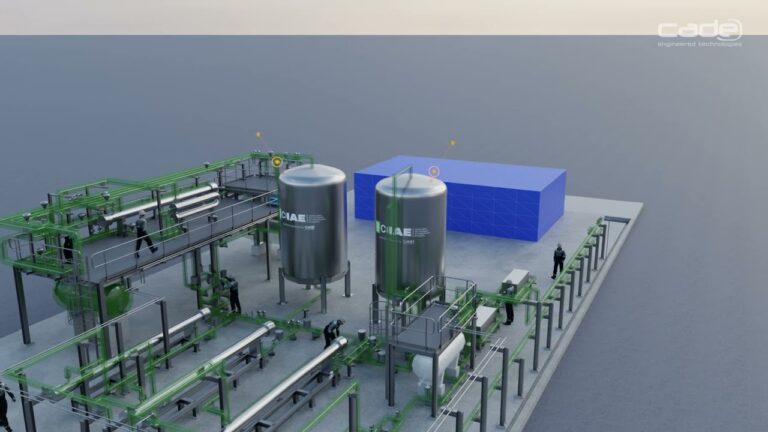

CADE Soluciones de Ingeniería, S. L. (CADE), an SME founded more than 20 years ago in the city of Albacete (Spain), with a clear strategic vision of sustainable energy development, has been investing for over a decade in the development of sensible heat (no phase change) thermal storage solutions in solid aggregates, TES–SHS. It is a thermal energy storage system based on a modular concept, made up of blocks of solid-state material.
A) solidTES thermal energy storage solution.
CADE’s TES–SHS, marketed as solidTES, is a thermal storage system conceptually based on a set of tubes carrying a thermal fluid (HTF, Heat Transfer Fluid) embedded in a block of high heat capacity material, whose composition can vary depending on the required temperature. The system can operate with different types of HTF, such as molten salts, thermal oil, air, pressurized hot water or steam, from both conventional and renewable sources. It can also be integrated with renewable thermal generation sources (concentrated solar power, biomass, renewable gases) and electrical sources (PV, green PPAs), or with waste heat recovery systems.
The modular layout makes it possible to reach the required storage capacity by adding standard modules. The system delivers the stored energy as usable heat at a defined temperature in the 150 °C – 500 °C range. solidTES has achieved a considerable improvement in thermal storage properties, gaining greater system stability and a better price-performance ratio compared with traditional molten salt thermal storage systems.
As noted earlier, achieving the full decarbonization of industry requires combining renewable energy sources of different kinds, such as concentrated solar thermal, photovoltaics, wind or the power grid, among others, forming an energy mix that must be managed optimally according to demand. The aim of solidTES is therefore to enable smart, on-demand management of a variable energy mix (electrical and thermal), offering renewable coverage of up to 100%; in other words, an integrated, decarbonized solution that gives industry energy independence from fossil sources.
CADE is currently in the midst of developing the 4th generation of solidTES, which, compared with previous generations, will improve electrical charging in terms of capacity per unit volume, since it will handle temperatures of up to 600 °C, and will offer versatile integration into different configurations of renewable generation/electrification and heat demand. In other words, the aim is to enable solidTES to operate as a battery, with charging and discharging in the form of both thermal and electrical energy.
Connecting solidTES to the grid through reverse thermodynamic cycles for electricity generation opens up a role in energy storage based on the thermal vector. However, managing the grid connection of this equipment autonomously has not yet been fully solved; it currently relies on manual human decisions based on very short-term time parameters. CADE, by contrast, is working on solutions for autonomous, smart grid connection, in which decisions are made by an electronic system that takes into account the large number of variables involved in a decision of this kind: bid price, demand forecasts and weather forecasts, with decisions taken not at the level of a single unit but across a fleet of distributed units belonging to the same energy utility. This optimizes not only the charging of the storage units but also the timing of discharge, whether in thermal mode for use within the plant itself, in electrical mode for the same purpose, or for export to the grid, depending on economic and demand parameters.

Figure 1. Conceptual operating diagram of the 4th-generation solidTES (own elaboration).
B) Energy Conversion.
The next step in the development of solidTES involves converting electrical energy into heat and vice versa.
To convert electricity into heat for the TES charging cycle, different technologies can be used:
- Resistive heating by the Joule effect.
- Heat pump, from a low-temperature source (cold reservoir) to a higher-temperature one (hot reservoir). Two types of thermodynamic cycles can be distinguished:
- Reverse Rankine cycle.
- Reverse Brayton cycle, proposed in 2017 by R. B. Laughlin for thermal charging/discharging.
- Others, such as the Claude cycle in liquid air storage systems, or the Lamm–Honigmann process for thermochemical cycles.
On the other hand, the following are used to convert heat into electricity:
- Thermodynamic cycles:
- Rankine cycle.
- Brayton cycle.
- Semiconductor materials, exploiting the thermal properties of certain materials.
- Lamm-Honigmann process for converting energy stored photochemically

Figure 2. Energy conversion systems applicable to TES – SHS (own elaboration).
C) Storage and the digitalization of industry.
For an energy storage system to make sense beyond its potential local use, serving an energy distribution network, it must be equipped with a degree of intelligence that not only takes production and consumption forecasts into account but also manages energy optimally. The power system is, after all, a set of loads and generators that must operate in a coordinated manner for the system to perform its function optimally.
Digitalization is playing a crucial role in the management of energy storage systems, bringing a range of benefits that optimize their operation and efficiency. Some key aspects are highlighted below:
- Storage Capacity Optimization.
- Load and Demand Management.
- Predictive Maintenance.
- Integration with Renewable Energy.
- Economic Optimization.
These two issues therefore cannot be separated, and the development of storage technologies must go hand in hand with corresponding developments in management systems, which will necessarily include Artificial Intelligence tools.
Conclusion
Spain is a pioneer in the deployment of renewable energy, but so far it has not been one in energy storage. Storage legislation is incomplete and scattered across various regulations issued by different bodies. However, there is a clear trend towards proper standardization, and important legislative steps are being taken. In fact, in 2021 the Council of Ministers, at the request of MITECO (Spanish Ministry for the Ecological Transition and the Demographic Challenge), approved an Energy Storage Strategy setting a target of 20 GW of total available storage capacity by 2030 and 30 GW by 2050.
In addition, Spain’s PNIEC (National Integrated Energy and Climate Plan) promotes innovation and the development of new storage technologies, recognizing their importance for the energy transition. Effective use of thermal storage can improve energy efficiency in sectors such as industry and construction, and help Spain meet its international and national commitments for a more sustainable future.
However, at present, and pending the corresponding legislative changes, there is no specific economic regime or incentive for selling stored energy, although there are calls for grants to build this type of facility
Therefore, energy storage is an essential tool for the future, among other reasons because of Spain’s status as an energy island, the need for system flexibility and the non-dispatchable nature of renewables
As shown, thermal storage offers a number of advantages in terms of cost, efficiency, capacity, integration with renewable energy, environmental impact and durability, making it an attractive option today for energy applications, both grid-connected and industrial.
Thermal storage, in addition to being useful in industries with intensive heat use, can therefore facilitate this transition by enabling greater integration of renewable sources, which are intermittent by nature. By storing surplus thermal energy produced during periods of high generation and releasing it when demand is higher, the stability and reliability of the power grid are improved.