
Regulatory developments at European Union level, and their transposition into Spanish law, underline the importance of energy storage in the transition to a more sustainable economy and in the integration of renewable energy into the power system, so that the goal of decarbonization can be achieved across the board.
However, despite this regulatory support, the structures of the state have not kept pace. Only very recently was a Royal Decree enacted setting out the organizational structure of the Ministry for the Ecological Transition and the Demographic Challenge (MITECO) to effectively address the challenges posed by the ecological transition and the fight against climate change. Royal Decree 503/2024 of 21 May 2024, amending Royal Decree 1009/2023, provides, among other things, for the creation of dedicated commissioners for Renewable Energy, the Water Cycle and the Circular Economy.
With regard to energy storage, the Royal Decree specifically establishes a Commissioner for Renewable Energy, Hydrogen and Storage, responsible for promoting the proper execution of the Recovery, Transformation and Resilience Plan funds. This commissioner is in charge of disseminating and promoting policies and plans for transforming energy transition value chains to ensure a secure, sustainable and affordable energy supply.
There is no doubt that this Royal Decree is fundamental to the structure and operation of MITECO, as it defines and clarifies the functions and responsibilities of its various directorates-general and sub-directorates-general.
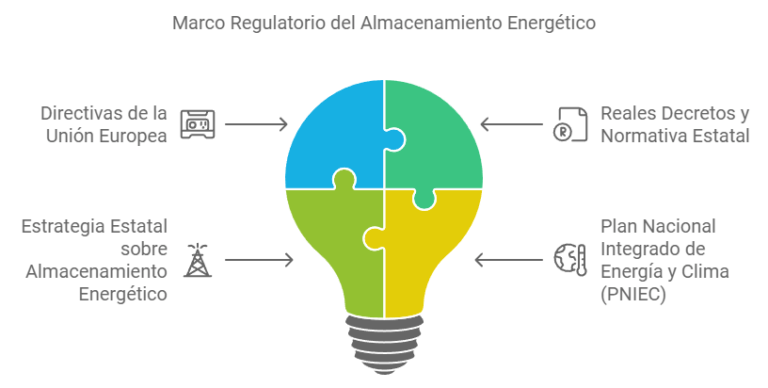
Regulatory Framework for Energy Storage
Below is a brief overview of the regulatory framework, highlighting some of the most relevant regulations, laws and decrees in this field:
a) European Union Directives
- EU Directive 2018/2001. It sets ambitious targets for increasing renewable energy and promotes energy storage as an essential part of the strategy. It was transposed into Spanish law through several legal instruments. One of the main ones is Royal Decree 1183/2020, which regulates access and connection to electricity transmission and distribution grids, thereby incorporating the directive’s provisions on the promotion of renewable energy and energy efficiency.
- EU Directive 2019/944, which regulates the participation of energy storage in the electricity market, including the provision of flexibility services on an equal footing with other energy resources. It was transposed into Spanish law through Royal Decree-Law 23/2020, and lays the foundations for the integration of renewable energy and the decarbonization of the economy.
b) Royal Decrees and National Regulations
- Royal Decree 17/2019, which establishes urgent measures to adjust the remuneration parameters of the electricity system and facilitate the closure of thermal power plants, thereby driving the transition to an emissions-neutral energy system.
- Royal Decree-Law 23/2020. Its provisions are incorporated into the Electricity Sector Act, establishing an updated regulatory framework to facilitate the integration of energy storage technologies and their hybridization with renewable generation facilities. This decree amends RD 1955/2000, which regulated the transmission, distribution, retail and supply of electricity and the authorization procedures for electrical facilities.
- Royal Decree 1183/2020, which implements Article 33 of Law 24/2013 on the Electricity Sector and, for the first time, regulates grid access for storage facilities that inject energy into the grid, allowing new or existing generation plants to be hybridized with storage systems. Furthermore, to encourage their deployment, it was established that, in capacity tenders, the inclusion of storage facilities could be considered an assessment criterion.
- National Integrated Energy and Climate Plan (PNIEC) 2021-2030: This plan sets targets and policies to increase energy storage, ensuring the efficient integration of renewable energy into the power system. It includes financial incentives and regulatory measures to promote the development of storage infrastructure.
- Royal Decree-Law 8/2023, which introduces a financial guarantee regime for energy storage facilities. Under this decree, a financial guarantee of 20 euros per kW requested is required for the access and connection of these facilities. This regime is currently being amended through a bill that seeks to eliminate the duplication of guarantees, a change long awaited by the sector to facilitate the development of energy storage in Spain.
C) National energy storage strategy.
In addition, and in line with the aim of fostering an effective transition, in early 2021 the Council of Ministers, on a proposal from MITECO, approved the Energy Storage Strategy, which will be key to ensuring the security, quality, sustainability and affordability of renewable energy supply. It focuses on developing efficient methods to capture and store energy, allowing it to be used when it is most needed. It involves technologies such as batteries, green hydrogen, and thermal and mechanical storage systems to optimize the management of renewable energy resources and improve power grid stability. The strategy explicitly targets a storage capacity of around 20 GW by 2030, rising to 30 GW by 2050, including both large-scale and distributed storage.
Conclusion
This regulatory framework reflects Spain’s commitment to the goals of the 2030 Agenda and the Paris Agreement, steering the country towards a more sustainable and energy-independent future.
Related CADE services: Thermal Energy Storage
Further information: International Energy Agency (IEA)