


Collaborative Palletizing | Safe, Scalable End-of-Line Automation
A collaborative palletizing solution developed to help transform a manual end-of-line process into a safer, more efficient and scalable industrial operation
The challenge:
The project started from a common industrial reality: an end-of-line operation based on manual handling and palletizing of boxes. This process created a high dependency on operator intervention, limited production continuity and exposed workers to repetitive, ergonomically demanding tasks.
The challenge was not simply to install a robot. It was to understand where the process was losing efficiency, how different product formats affected the workflow, and what type of automation could generate real value without disrupting the existing plant operation.
The line had to handle different box dimensions, weights and palletizing patterns, while maintaining a continuous production pace of 5 to 7 boxes per minute. Frequent format changes, limited downtime and the need to keep the environment safe for operators made flexibility a key requirement from the beginning.
The solution also had to be viable for real plant conditions: compact, easy to operate, adaptable to production changes and capable of integrating into the existing workflow without relying on a rigid fenced robotic cell.
This context made collaborative palletizing a suitable automation strategy, as long as the solution could respect the existing workflow, reduce manual effort and remain flexible enough to adapt to real production conditions.
From an operational perspective, this collaborative palletizing project also helps standardize the end-of-line process. By reducing variability in manual handling, the plant gains a more reliable workflow, better control over palletizing sequences and a safer working environment for operators. This makes the solution valuable not only as an automation upgrade, but also as a practical step toward a more efficient and scalable production model.
The Solution
CADE designed and implemented a collaborative palletizing solution conceived to improve productivity, safety and flexibility at the end of the line.
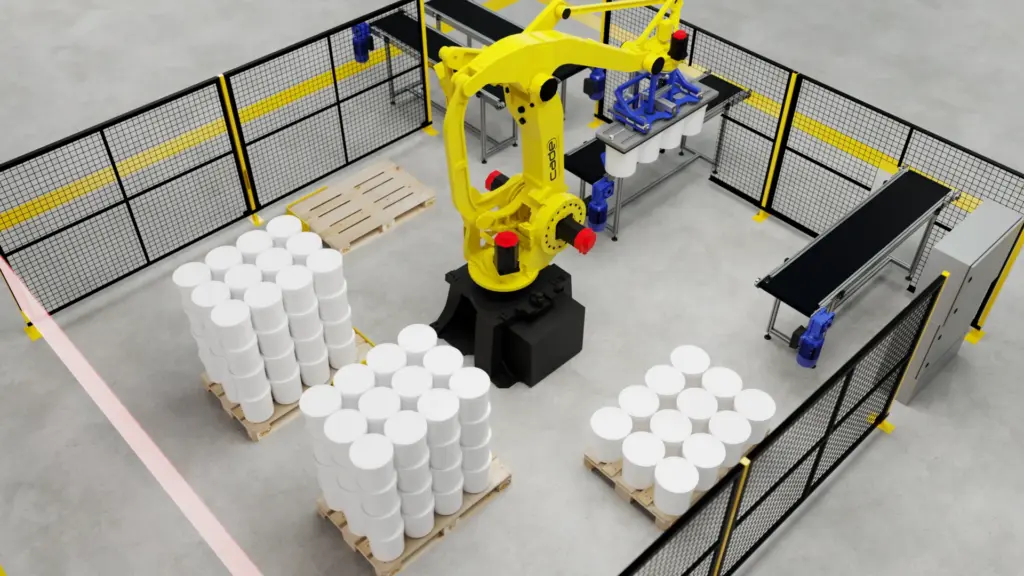
The solution is based on a collaborative robot capable of managing two pallet positions. This configuration allows the system to maintain continuous operation: while the robot completes one pallet, the operator can remove the other and place a new empty base, reducing interruptions and improving workflow efficiency.
The robot is equipped with a vacuum gripping tool with interchangeable suction cups, allowing the system to handle different types of packaging. Positioning sensors ensure precision in each cycle, while the electrical and pneumatic architecture supports reliable and repeatable operation.
The system also includes an intuitive user interface designed to simplify operation and format changeovers. This allows production teams to adapt the cell to different references without requiring advanced programming skills.
The project was approached as a complete industrial solution, covering engineering, design, manufacturing, integration, validation, commissioning and operator training. This ensured that the technology was not only technically feasible, but also ready to operate in the real production environment. The result is not a standalone robotic device, but a collaborative palletizing cell designed around the process, the operators and the operational rhythm of the plant.
Technologies and capabilities applied
- Industrial integration
- Vacuum gripping system
- Control and automation
- 3D simulation and validation
- Automatic tracking
- Collaborative robotics
- Mechanical and electrical engineering
Results
The solution improves end-of-line productivity by reducing the time associated with manual handling and enabling a more continuous and stable operation.
Automation reduces or eliminates repetitive and ergonomically demanding tasks, improving operator safety and reducing exposure to sustained physical effort.
The dual-pallet position configuration helps maintain operation during changeovers, optimizing workflow and reducing downtime.
The system’s flexibility allows it to adapt to different formats within minutes, improving responsiveness to production changes and supporting the future evolution of the line.
In addition, automation brings greater process stability, improves operational repeatability and strengthens palletizing traceability.
For the production team, collaborative palletizing also creates a more controlled and future-ready operation. The line gains flexibility to respond to format changes, reduces dependency on repetitive manual work and provides a scalable foundation for further automation initiatives within the plant.
Describe your case and a CADE specialist will review it.
Other projects
- Piping and Ducts, Power Plants

- Ingeniería
- Smart Factories